Home Home

Home

  • Overview of Key Issues in the Pre-Election Period for the June 18, 2022 Ekiti State Governorship Election (Pre-Election Press Statement)

    Overview of Key Issues in the Pre-Election Period for the June 18, 2022 Ekiti State Governorship Election (Pre-Election Press Statement)

    T
    he first of two off cycle governorship elections for 2022 will be conducted by the Independent National Electoral Commission (INEC) in Ekiti State, on June 18, 2022. The election is the seventh in the state since the return of the current democratic dispensation in 1999. Following a 2010 Court of Appeal verdict, which removed then Governor Segun Oni, and declared Dr. Kayode Fayemi the rightful winner of the 2007 governorship election, Ekiti became one of several states holding off cycle governorship elections. The June 18, 2022 Ekiti State gubernatorial election is the very first to be conducted under the amended Electoral Act, 2022.

    As voters in Ekiti State head to the polls for tomorrow’s governorship election, the contest is apparently shaping up to be a three horse race involving the ruling party in the state, the All Progressives Congress (APC), the opposition Peoples Democratic Party (PDP) and the Social Democratic Party (SDP), which has clearly emerged as a third force in the election. CDD observes that there are 16 political parties fielding candidates for the election. Only two candidates and seven deputy governorship candidates are women, just as the age range of the candidates indicate low participation of the youth.

    The CDD EAC will be closely observing the electoral process with the objective of collecting data to support evidence-based analysis of key aspects of the Ekiti State governorship election. The CDD EAC will also host a fake news hub for the purpose of tracking and countering fake news and misinformation as it affects the election.

    Pre-Election Observations

    Based on the observation of the CDD EAC in the pre-election period, the following are the key trends, which have underlined the process.

    CDD notes that the June 18, 2022 Ekiti State Governorship election is significant because it will serve as the first dress rehearsal as the INEC prepares for the 2023 general elections. The election will also be the first to be conducted under the Electoral Act, 2022, and the new INEC guidelines and regulations for conduct of elections. CDD EAC further notes that although INEC has made commitments to conduct a credible election in Ekiti State, its success in this regard would depend on its neutrality, professionalism and the level of its understanding and commitment to the new legal framework. The credibility of the process would also depend on how well INEC uses some of its new powers as derived from the extant electoral law, especially the power conferred on the Commission to delay the release of election results, if the Commission needs to take a second look.

    The CDD EAC is concerned about violence, money politics and violations of incumbency powers and the possible effects of these on the credibility of the election. CDD EAC notes that Ekiti State, has recorded several incidents of violence during previous elections. In the build up to the 2022 governorship election, pockets of election-related violence have been recorded in places like Ado Ekiti, Efon Alaiye, Oye, Ido/Osi and Oye Ekiti. Other observable issues, which would shape the credibility of the election include; how well INEC is able to effectively deploy technology, particularly the Bimodal Voter Accreditation System (BVAS), impartial security provisioning, the quality of results management, curtailing the role of money, incumbency and god fatherism in the election. Also critical is the need for stakeholders in the election to proactively track, and counter fake news and misinformation. Already, the pre-election period has witnessed the spread of fake news capable of undermining voter confidence and participation in the process. An example is the fake news which trended recently on a purported Appeal Court decision nullifying the primaries of one of the major political parties and, by extension, its candidate.

    In terms of some of the election risk factor, CDD notes that the ongoing strike by the Academic Staff Union of Universities ( ASUU) has crippled the local economy especially in university towns in Ekiti State. This has created a threat in terms of the availability of idle youth being recruited for activities, which could undermine the credibility of the election. By grounding the local economy, the strike has also created the wrong incentives as voters are more likely to see the election as an opportunity for economic survival, thereby exacerbating the risk of vote buying. This becomes even more relevant when it is considered that Ekiti State introduced the issue of “stomach infrastructure” into the Nigerian political lexicon. CDD has also observed that based on history of past violence in elections in the state, the following Local Government Areas, constitute potential flash points in the election; Ado Ekiti, Efon Alaiye, Ido/Osi, and Oye.

    Signed:

    Professor Adele Jinadu

    Chair, CDD EAC

  • FACT CHECK: Did Nigerian Lawmakers Move to Stop Betting in Nigeria?

    The claim that Nigerian lawmakers are taking steps to halt sports betting in the country has been widely circulated, particularly by Instablog, a popular gossip blog with a substantial following on Twitter and Instagram. 

    According to their post, the House of Representatives is on the verge of stopping sports betting in Nigeria, following the adoption of a motion by Kelechi Nwogu. 

    There have been concerns regarding the perceived detrimental effects of sports betting on the Nigerian populace. Many individuals are grappling with addiction to this habit, raising fears about its potential societal impact. According to BussinessDay, research conducted by NOI Polls sheds light on the scale of sports betting in Nigeria, it reveals that Nigerians collectively spend over N730 billion annually on this activity. Moreover, an estimated N2 billion is generated daily from sports betting alone. The data further indicates that over 60 million Nigerian punters spend at least N3,000 daily on bet stakes. Additionally, the proliferation of betting sites in Nigeria is evident, with the current count standing at around 50, and this number continues to grow each year.

    Claim: Did Nigerian Lawmakers move to stop sports betting in Nigeria?

    Verification

    Upon examining the claim, the CDD War Room found that Kelechi Nwogu, a lawmaker representing the Etche/Omuma federal constituency, indeed moved a motion before the House of Representatives regarding the need to address the adverse effects of sports betting. 

    In his motion, Nwogu emphasised the importance of taking measures to mitigate the harmful impacts of sports betting while also advocating for the protection of the rights of Nigerians, who engage in sports betting. He specifically requested that the House invite the national lottery regulatory commission to address these concerns and ensure adequate safeguards for players. Contrary to circulating claims, however, he did not call for an outright ban on the activity.

    To further dispel any misconceptions, the lawmaker’s Twitter handle addressed the issue, attributing the inaccurate information to the microblogging platform. This underscores the importance of verifying information from credible sources and avoiding the spread of misinformation, especially on social media platforms. 

    Verdict

    Inaccurate. 

    The lawmaker did not move a motion to ban sports betting in Nigeria, but rather moved a motion to protect players rights and ensure compliance with regulatory provisions. 

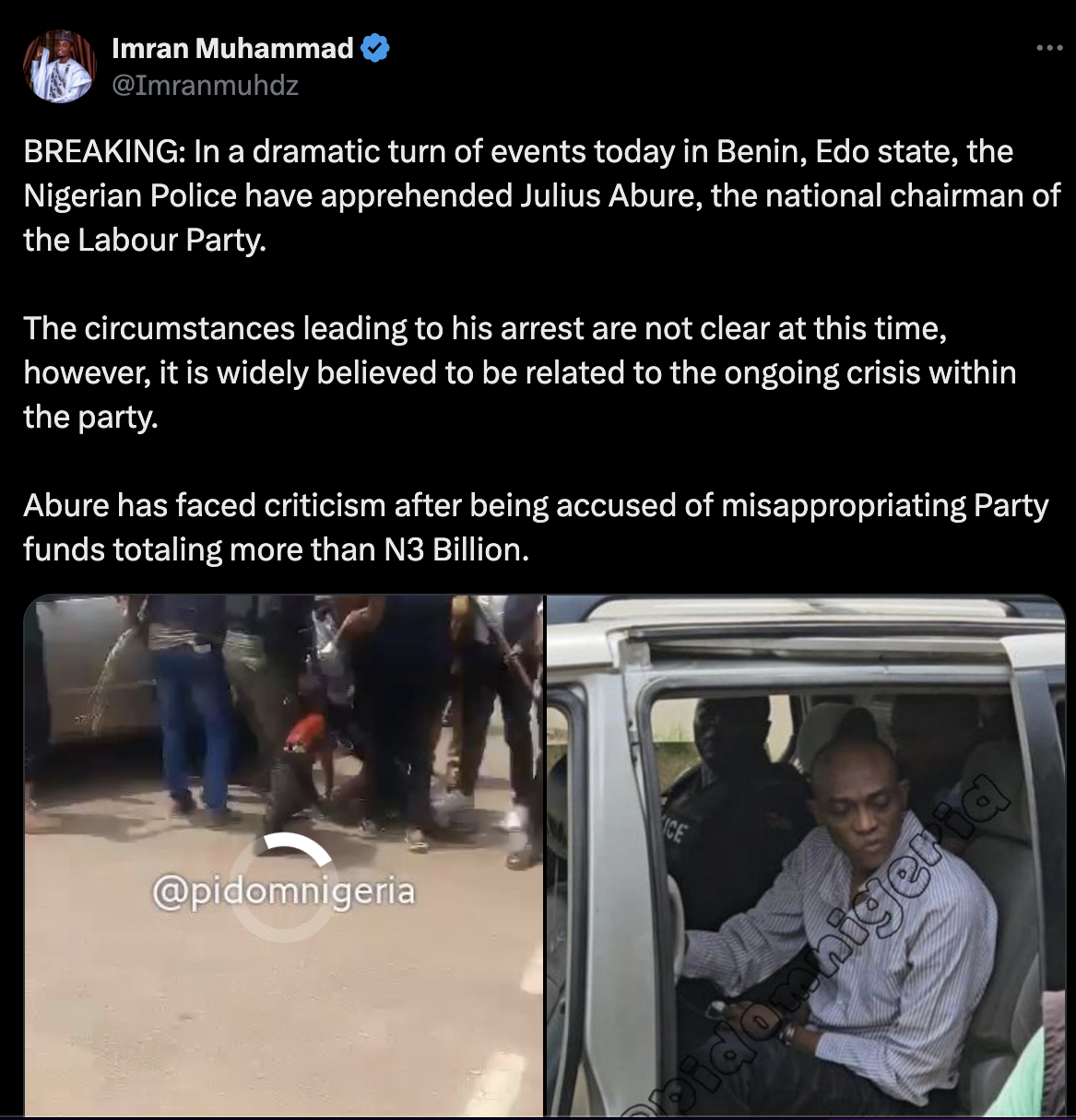
  • FACT CHECK: Did The Nigerian Police Apprehend Julius Abure, Labour Party’s National Chairman?

    FACT CHECK: Did The Nigerian Police Apprehend Julius Abure, Labour Party’s National Chairman?

    On February 21, 2023, an X user (formerly Twitter) tweeted that Julius Abure had been apprehended by the Police. Attached to the tweet is a video and picture allegedly showing the moment he was apprehended. 

    “BREAKING: In a dramatic turn of events today in Benin, Edo state, the Nigerian Police have apprehended Julius Abure, the national chairman of the Labour Party (LP).

    The circumstances leading to his arrest are not clear at this time. However, it is widely believed to be related to the ongoing crisis within the party.

    Abure has faced criticism after being accused of misappropriating Party funds totaling more than N3 Billion.”

    This development comes a few days after Peter Obi, the presidential candidate of the Labour Party in 2023, announced the commencement of the public accounting process for the Obi-Datti campaign funds for the 2023 general election. 

    Claim I: The video shows the Nigerian Police apprehending Julius Abure 

    Verification

    The CDD War Room found that the circulated video originated from a Twitter account (@PIDOMNIGERIA). We found that credible media organisations posted the story of the arrest and credited PIDOMNIGERIA. We found that he was released in the wee hours of Wednesday, the same day he was arrested. According to the Police Public Relation Officer (PRO), Zone 5, Edo State, Abure was arrested based on a petition and in connection to attempted murder.

    However, there are different versions of the reason and cause of the arrest. Some of them can be found here and here

    We reached out to the Labour Party executives but they declined to comment on the development. 

    Verdict: TRUE

    The CDD War Room can confirm that Julius Abure was arrested in Benin, Edo State. We found that the circulated video was retrieved from the scene of his arrest. However, we could not ascertain the reason for his arrest. 

    Claim II: Julius Abure is accused of misappropriating party funds totalling N3 billion

    Verification

    On February 12, 2024, Oluchi Oparah, the national treasurer of the Labour Party, revealed that the party earned about N3.5 billion from the sales of forms and other fundraising activities for the 2023 general elections in the country. However, the chairman, Julius Abure, has failed to account for the fund, which translates to misappropriation. She said, “With great reluctance and deep concern, I am compelled to publicly address the media regarding the egregious financial mismanagement and corruption that have plagued our beloved party under the leadership of Mr Julius Abure, the current National Chairman………

    As national treasurer, I am constrained to come before you and the public today because the internal mechanisms of our party have failed woefully to bring Mr. Abure to account for his brazen abuse of office and misappropriation of party funds.”

    In another account, the LP, via its official website, published that the chairman has cleared the air on the allegation raised by the treasurer. Similarly, Abure appeared before the Arise News Channel to explain his side of the story about the misappropriation of N3.5 billion. 

    He said, “The total summary of the money that entered into the party was N1.3 billion. We also got N700m for the campaign. I want to challenge her to make the records available where she got the sum of N3.5 billion.” Abure further added that he would file a case of defamation against the national treasurer, Oluchi Oparah. 

    ALL WE KNOW

    The LP national treasurer alleged that the party chairman, Julius Abure, received N3.5 billion for the 2023 election and failed to account for the earned funds. She added that the chairman misappropriated the fund, totalling N3.5 billion.

    However, the national chairman has revealed that the party earned about N1.3 million and another N700 million, totalling N2 billion. He reiterated that the funds earned were not misappropriated and were duly accounted for. 

  • FACT CHECK:  Does video show stacks of printed naira notes in a warehouse in Northern Nigeria?

    Over the week, a video circulated across various social media pages with the caption, “This is Nigeria 🇳🇬. Stack of newly printed Naira =N= found in a big warehouse in Northern Nigeria 🇳🇬”

    This comes amidst the continuous skyrocket of prices of goods and services across the country.

    Claim: Video shows stack of printed naira notes in a warehouse in Nothern Nigeria

    Verification

    On February 12, 2024, the Kano State Public Complaints and Anti Corruption Commission raided and sealed ten warehouses containing assorted foodstuffs in the Dawanau area of Dawakin Tofa Local Government Area of the state. Amidst the rising food prices, the Kano State Anti-corruption officials visited the warehouse inside Dawanau market, Kano State, Nigeria and uncovered food items such as Spaghetti and Noodles stacked in large quantities in the market. The officials immediately sealed the warehouse, alleging that the owners of the warehouse hoarded the goods to create artificial scarcity.

    Verdict: FALSE

    The CDDWarRoom can confirm that the video being circulated is a warehouse stacked with grains, spaghetti and noodles, not newly printed Naira notes. The warehouse is among the ten warehouses sealed by the Kano State Public Complaints and Anti-Corruption Commission. The video has no connection whatsoever with new Naira notes.

  • FACT SHIELD: Consensus, Direct or Indirect Primaries?

    FACT SHIELD: Consensus, Direct or Indirect Primaries?

    Ahead of the off cycle Edo and Ondo Governorship election slated for September and October 2024 respectively, there have been mixed reactions regarding the kind of primaries to be conducted by the political parties. Recently, one of the aspirants under the All Progressives Congress (APC) platform, Diran Iyantan, called for a direct primary mode for APC. While the political parties have not declared what mode of primaries they would be using, CDD War Room found it necessary to produce this explainer on the various modes of primaries and how aspirants can emerge to become candidates in the various political parties. 

    What are the Modes of Primary Elections in Nigeria?

    According to the Electoral Act 2022 (as amended), the nomination of candidates by political parties should be through primary elections ahead of presidential, state governorship, and legislative house elections. 

    Section 84(1) of the Electoral Act added further details that a political party seeking to nominate candidates for election under this Act shall hold primaries for aspirants to all elective positions, which shall be monitored by the Independent National Electoral Commission (INEC).

    Section 84 (2) provides that the procedure for nominating candidates by political parties for the various elective positions shall be by direct, indirect primaries or consensus

    Direct Primaries

    According to Section 84 (4), direct primaries imply that the members of the political party will be given an equal opportunity to vote for a party member of their choice as the nominated candidate of the party. This direct mode of primaries will involve the participation of all registered party members in selecting the party’s candidates. 

    Procedures for Direct Primaries

    (4) A political party that adopts the direct primaries procedure shall ensure that all aspirants are given equal opportunity of being voted for by members of the party and shall adopt the procedure outlined –

    (a) in the case of presidential primaries, all registered members of the party shall vote for aspirants of their choice at a designated centre at each ward of the Federation;

    (b) the procedure under paragraph (a) shall be adopted for direct primaries in respect of Gubernatorial, Senatorial, Federal and State Constituencies;

    (c) Special conventions or congresses shall be held to ratify the candidate with the highest number of votes at designated centres at the National, State, Senatorial, Federal and State Constituencies, as the case may be.

    Indirect Primaries

    As for the indirect primaries, members of the political party will (firstly) democratically elect delegates at the party’s congress, and, in turn, the delegates will elect the party’s candidates on behalf of the members of the political party. That is, a large number of party members will elect delegates to represent them and vote for the aspirants of their choice, who will then become the party flagbearer.  Section 84 (5 – 8) of the Electoral Act 2022 (as amended) generally stipulates the procedure for the conduct of indirect primaries in Nigeria. 

    Procedures for Indirect Primaries

    The summary of the procedures for the indirect primary is that the political party shall hold a special Presidential, Governorship, Senatorial District, Federal constituency and State Assembly convention at a designated centre in any place within the Federation that is agreed to by the National Executive Committee of the party where delegates shall vote for aspirants of their choice. Thereafter,

    (ii) The aspirant with the highest number of votes cast at the end of voting shall be declared the winner of the primaries of the political party. That aspirant’s name shall be forwarded to the Commission as the candidate of the party. 

    (b) in the case of nominations to the position of a Governorship candidate, the political party shall, where it intends to sponsor candidates –

    (i) hold a special congress in the State Capital or any other place within the State with delegates voting for aspirants of their choice at the congress to be held on a specified date appointed by the National Executive Committee (NEC) of the party.

    Consensus Candidacy

    The third mode of primary election is the system of consensus candidacy whereby all aspirants in the political party will voluntarily and expressly withdraw from the primaries and endorse a single candidate. In this consensus mode, the party does not conduct any election; they only affirm the choice of a single aspirant as the candidate. In an instance where there is no such express withdrawal, the political party will mandatorily conduct direct or indirect primaries. 

    Section 9 (a) of the Electoral Act 2022 (as amended) provides that “A political party that adopts a consensus candidate shall secure the written consent of all cleared aspirants for the position, indicating their voluntary withdrawal from the race and their endorsement of the consensus candidate;” 

    However, section 9 (b) provides an alternative when a party fails to reach a consensus. It says, “Where a political party is unable to secure the written consent of all cleared aspirants for the purpose of a consensus candidate, it shall revert to the choice of direct or indirect primaries for the nomination of candidates for the aforesaid elective positions.”

  • Fact-checking Kaduna governor, Sani’s claims about poverty rate in Northwest, illegal arms proliferation in Nigeria

    Fact-checking Kaduna governor, Sani’s claims about poverty rate in Northwest, illegal arms proliferation in Nigeria

    The governor of Kaduna state, Uba Sani, has made multiple claims regarding the rate of poor people in the Northwestern region of Nigeria and the proliferation of illegal firearms in the country.

    The governor, who is a former chairman of the Senate Committee on Banking, made the assertions during a recent exclusive interview with TVC News. 

    While speaking on the need for good governance as a means of tackling insecurity, Sani said, “As we are speaking, 80-85 percent of people that live in the Northwest are living below the poverty line. That is the level of poverty there, and that can only change if we have good governance.”

    Claim I: 80-85% percent of people living in the North West region are living below the poverty line

    Verification

    The North West is recognized as the largest geo-political zone in Nigeria, encompassing seven states which are Kaduna, Kano, Katsina, Kebbi, Jigawa, Sokoto, and Zamfara. According to the 2006 Census, the population of the North West was quoted to be 35,786,944, constituting 25.56% of the country’s population.

    In a 2023 report by the African Development Bank, the North West population was estimated at 60 million, representing 28% of the country’s population. Similarly, Premium Times reported in November 2023 that the North West was ranked as the poorest sub-region in the country with 45.5 million poor residents.

    These statistics show that the rate of poor people living in the North West falls below the 80-85% range. With an estimated population of 60 million, 80-85% of the population would mean that between 48 and 51 million people living in the zone are poor. However, recent data show that the sub-region has 45.5 million poor residents, representing 75.8 percent of the estimated population. 

    Verdict: INACCURATE

    Claim II: More than 70% of the 350 million illegal arms in circulation in West Africa, are in Nigeria

    While speaking on the spate of insecurity in the country, the Kaduna state governor expressed concern about giving money to armed bandits in a bid to negotiate with them. He argued that the unscrupulous elements end up using the money paid to them for the purchase of more firearms. 

    Sani said, “There was an alarming report by the United Nations that about 350 million arms are in circulation in Sub-saharan Africa, West African region precisely. More than 70% of the arms are in circulation in Nigeria.”

    Verification

    In 2016, the United Nations Regional Centre for Peace and Disarmament in Africa (UNREC) raised alarm regarding the illicit proliferation of Small Arms and Light Weapons (SALW) in Nigeria. According to a report by the Vanguard, UNREC revealed that Nigeria accounted for over 350 million or 70 per cent of the estimated 500 million weapons circulating in West Africa.

    A co-sponsor of a bill to regulate SALW in Nigeria, Nnenna Ukeje, quoted the statistics on the floor of the Federal House of Representatives in 2018. 

    Ujeke stated that 70% of over 500 million small arms and light weapons circulating in West Africa were in Nigeria, Daily Trust reported.

    In 2021, while serving as a lawmaker representing Kaduna Central and as the sponsor of the Firearms Amendment Bill, Uba Sani reiterated the same statistics on the floor of the Senate, stating that 350 million out of the 500 million illegal weapons circulating in West Africa were domiciled in Nigeria.

    Furthermore, A 2021 report by the United Nations Office on Drugs and Crime (UNODC) stated that over 70 percent of about 10 million illegal weapons in West Africa were in Nigeria.

    Verdict: MISLEADING

    The UN statistics cited by Uba Sani actually indicated that Nigeria harboured over 350 million or 70% of an estimated 500 million illegal weapons circulating in West Africa. 

  • FACT CHECK: Does viral video show the moment helicopter carrying Herbert Wigwe, others crashed?

    FACT CHECK: Does viral video show the moment helicopter carrying Herbert Wigwe, others crashed?

    A video has been widely circulated on social media, claiming to depict the moment the helicopter carrying Herbert Wigwe, the late CEO of Access Holdings Plc, and others crashed.

    The video, shared by Naija2023_election on Instagram, as archived here, shows an aircraft engulfed in flames after crashing to the ground, with a helicopter hovering in the air at the accident scene.

    Accompanying the video are pictures of Wigwe and his family, with the caption, “sad one.”

    Screenshot of the archived Instagram post

    The Labour Party gubernatorial aspirant in Edo state, Stephen Osemwegie, who recently declared his withdrawal from the race, also shared the video on his X handle with the caption, “Major National Disaster! Crash site of Access Bank CEO’s helicopter”.

    Screenshot of Osemwegie’s archived post on X

    The same footage was also shared by multiple users and blogs across Instagram, YouTube, and X, as archived here, here, here, here, here, and here.

    On Saturday, February 10, 2024, Wigwe was reportedly killed in a helicopter crash along with his wife, son, and a former group chairman of the Nigerian Exchange Group Plc, Abimbola Ogunbanjo. The helicopter crash occurred near the California-Nevada border in the United States of America.

    Claim: Viral video shows the moment a helicopter carrying Herbert Wigwe crashed

    Verification

    The CDD War Room checked to verify the viral video and here is what we found. We observed that the crashed aircraft engulfed in flames in the viral video is not a helicopter. We further traced the source of the video and found that it was a crash accident involving a private jet in Florida.  

    Daily Mail reported the jet crash on Friday, February 9, 2024. According to the report, the private jet smashed into a Florida freeway while flying from Ohio to the Sunshine State, killing two people. This was also reported by multiple media outlets as can be seen here, here, and here.

    Verdict: FALSE

    The CDD War Room can confirm that the viral video shows the moment a private jet flying from Ohio to Fort Lauderdale crashed on Naples highway in Florida. Multiple media outlets reported the crash on Friday, February 9, 2024.  

  • FACT CHECK: Did CDD’s report reveal 24 terrorist cells in Katsina as claimed in The Sun?

    FACT CHECK: Did CDD’s report reveal 24 terrorist cells in Katsina as claimed in The Sun?

    A news article emanating from The Sun claimed that a United Nations and Centre for Democracy and Development (CDD) research report unveiled 24 terrorist cells in Katsina as well as named their leaders. The news report which was published on January 25, 2023, also stated that the state had a total of 2,295 terrorists with Damburun having 385 terrorists populating the forest camp located in Kankara Local Government Area.

    The report comes days after its recent training for journalists in the Katsina state. The training sought to enhance the capacity of journalists to advocate for transitional justice as a means of reconciliation, resolution, and peace-building.

    The news report by The Sun was also published by another media Prime Time news with a similar headline. CDD War Room embarked on an investigation to determine the veracity of the claim.

    Claim: CDD unveils 24 terrorist cells, lists the number of terrorists in Katsina 

    Verification

    CDD War Room spoke with Sulieman Kura, a professor at the Usman Dan Fodio University Sokoto. Kura is the author of the report being cited and acted as one of the facilitators at the training organised by the CDD. Kura confirmed that during the training, the mention of terrorist cells as well as the total number of terrorists in the state were cited. However, he noted that the news report misappropriated the quote.

    According to him, both the cells and figures were from a report which was published over three years ago and was cited during the training and the presentation of the report as a background to what was being discussed. He further confirmed that the report presentation was done via PowerPoint as the report had not been officially published.

    Kura also explained that the figures and mappings cited were all contained in the previous report which was in the public domain and hence was not part of his recent research. Consequently, the CDD released an official statement debunking the newspaper report, while stating that the news report was “used out of context and there was nowhere such a tantalizing statement appeared in CDD’s 175-page draft report.”

    Verdict: Misleading

    The report by The Sun was taken out of context in a way which suggested that the report being released by CDD revealed the presence of terror cells in Katsina. The presenter at the capacity building session merely referred to a three year old report, which is in public domain. 

  • FACT CHECK: Did Kogi State Traders Protest Against Tinubu’s Government

    FACT CHECK: Did Kogi State Traders Protest Against Tinubu’s Government

    During the week, social media and the internet have been afloat with reports of protests against hardship from the government of President Tinubu of Nigeria.

    According to the trending reports, the protest was carried out by market women and men who protested the increasing prices of goods which has also affected patronage of their businesses. 

    Claim: Traders protest against Tinubu Government in Kogi?

    Verification:

    To confirm the veracity of the claim, the CDD War Room conducted both keyword and reverse image searches.

    We discovered that the report in question had been published by several media outlets, all featuring similar headlines and the exact picture. 

    However, during our investigation, we came across a report from Kogi Reports that showcased a slightly different image from the one circulated.

    To further validate the claim, we reached out to our soldiers of mouth in Lokoja. 

    We however got conflicting responses as they were not able to ascertain if the protest actually happened. 

    Verdict: All we know

  • FACT CHECK: Is Claim About Sack of Tinubu’s Chief of Staff True?

    FACT CHECK: Is Claim About Sack of Tinubu’s Chief of Staff True?

    There is currently a circulating claim that Bola Tinubu, the Nigerian president, has dismissed Femi Gbajabiamila, his chief of staff. The report, labelled as a developing story and posted on February 6, 2024, suggests that the official announcement of Gbajabiamila’s removal will be made public. This information was reposted by the “phoenix app” and widely shared across WhatsApp platforms.

    Controversy has surrounded some members of Tinubu’s cabinet, and it appears that Gbajabiamila is not exempt from this scrutiny. Gbajabiamila assumed the role of chief of staff to the president in June 2023, a position that required him to relinquish his former role as the speaker of the House of Representatives.

    In October 2023, the Daily Post reported that some of Tinubu’s loyalists were advocating for Gbajabiamila’s dismissal, alleging that he engaged in trading appointments “with the highest bidder.” 

    In response to the allegations, BusinessDay reported that the president expressed his “absolute confidence” in his chief of staff.

    However, in January 2024, unverifiable sources, primarily on social media, claimed that the suspended minister of humanitarian affairs and poverty alleviation, Betta Edu, intended to implicate Gbajabiamila in the corruption deal for which she was suspended.

    In February 2024, Gbajabiamila took action by writing a petition to the Department of State Services (DSS), urging an investigation into the false accusations and what he deemed a “sustained campaign of calumny.” He asserted that this campaign has been targeting him for more than six months since his appointment as chief of staff.

    Verification:

    In scrutinising the claim, the CDD War Room conducted a thorough examination of the news source and discovered that the information was initially posted on the website “abujareporters.com.” However, we found that the story had been subsequently deleted, adding a layer of ambiguity to the authenticity of the reported dismissal.

    Furthermore, the CDD War Room engaged with the state house correspondent.

    The correspondent, upon inquiry, conveyed a lack of awareness regarding such news.

    The CDD War Room was able to confirm that, as of yesterday evening, Femi Gbajabiamila was actively participating in a closed-door meeting in his capacity as the chief of staff. 

    This tangible evidence contradicts the claim of his dismissal and suggests that he was still functioning in his official role at the time.

    Verdict: FALSE

    After detailed checks, CDD War Room can confirm that there is no credible report to substantiate the claim of the sack of the Chief of Staff. As at the time of this report, Femi Gbajabiamila remains the chief of staff to the president.

  • FACT CHECK: Did the EFCC say it is going after a church for receiving N7 billion fraud proceed? 

    FACT CHECK: Did the EFCC say it is going after a church for receiving N7 billion fraud proceed? 

    On February 1, 2024, The Punch Newspaper tweeted via its verified X account (formerly Twitter) that “EFCC goes after church for receiving N7bn fraud proceeds.” Attached to the tweet is a news publication detailing the revelation of the EFCC chairman, Ola Olukoyede. He allegedly made the revelation on Wednesday at the Musa Yar’Adua Centre, Abuja, during a one-day dialogue on “Youth, Religion, and the Fight against Corruption.”

    According to the publication by The Punch Newspaper, they said  “though he did not reveal the identity of the religious organisation, a source in the anti-agency privy to the case told our correspodent that it was a church.

    Claim: The EFCC chairman said the EFCC is going after a church for receiving N7 billion fraud proceed

    Verification:

    On January 31, 2024, the EFCC chairman, Ola Olukayode, spoke at the EFCC Anti-corruption national dialogue in Abuja. The event was organised by the anti-graft agency to address the challenges of youth involvement in cybercrimes. 

    The one-day dialogue was themed  “Youth, Religion, and the Fight against Corruption.” While speaking, the chairman revealed the roles of religious organisations, institutions, sects, and bodies in aiding and abetting fraudsters and terrorists. 

    In his speech, he said “As I’m standing before you, there is a matter we are handling, a pyramid scheme that involves over N30 billion fleeced from Nigerians. Along the line, some people died, some victims collapsed and all of that. We were able to trace over N7billion to a particular religious body. I said, write a letter to the leader of that religious sect, and we did. The next thing we saw was a restraining order. We got a restraining order stopping us from inviting them, stopping us from recovering the money….”

    The CDD War Room also found a statement signed by Dele Oyewale, the head of  Media & Publicity at the EFCC Headquarters. The statement clarified the speech allegedly made by the EFCC chairman. We also reached out to the EFCC spokesperson who clarified that “the chairman did not mention a church, mosque or shrine. He said a religious body and their investigation is ongoing.” 

    Verdict: MISLEADING

    The CDD War Room found that the EFCC chairman, Ola Olukoyede, did not mention that the anti-graft agency is going after a church for receiving N7 billion fraud proceed. As at the time of this fact check, the helmsman of the anti-graft agency revealed the commission had traced over N7billion to a particular religious body but did not specify which of the specific religious body was culpable.