Home Home

Home

  • Overview of Key Issues in the Pre-Election Period for the June 18, 2022 Ekiti State Governorship Election (Pre-Election Press Statement)

    Overview of Key Issues in the Pre-Election Period for the June 18, 2022 Ekiti State Governorship Election (Pre-Election Press Statement)

    T
    he first of two off cycle governorship elections for 2022 will be conducted by the Independent National Electoral Commission (INEC) in Ekiti State, on June 18, 2022. The election is the seventh in the state since the return of the current democratic dispensation in 1999. Following a 2010 Court of Appeal verdict, which removed then Governor Segun Oni, and declared Dr. Kayode Fayemi the rightful winner of the 2007 governorship election, Ekiti became one of several states holding off cycle governorship elections. The June 18, 2022 Ekiti State gubernatorial election is the very first to be conducted under the amended Electoral Act, 2022.

    As voters in Ekiti State head to the polls for tomorrow’s governorship election, the contest is apparently shaping up to be a three horse race involving the ruling party in the state, the All Progressives Congress (APC), the opposition Peoples Democratic Party (PDP) and the Social Democratic Party (SDP), which has clearly emerged as a third force in the election. CDD observes that there are 16 political parties fielding candidates for the election. Only two candidates and seven deputy governorship candidates are women, just as the age range of the candidates indicate low participation of the youth.

    The CDD EAC will be closely observing the electoral process with the objective of collecting data to support evidence-based analysis of key aspects of the Ekiti State governorship election. The CDD EAC will also host a fake news hub for the purpose of tracking and countering fake news and misinformation as it affects the election.

    Pre-Election Observations

    Based on the observation of the CDD EAC in the pre-election period, the following are the key trends, which have underlined the process.

    CDD notes that the June 18, 2022 Ekiti State Governorship election is significant because it will serve as the first dress rehearsal as the INEC prepares for the 2023 general elections. The election will also be the first to be conducted under the Electoral Act, 2022, and the new INEC guidelines and regulations for conduct of elections. CDD EAC further notes that although INEC has made commitments to conduct a credible election in Ekiti State, its success in this regard would depend on its neutrality, professionalism and the level of its understanding and commitment to the new legal framework. The credibility of the process would also depend on how well INEC uses some of its new powers as derived from the extant electoral law, especially the power conferred on the Commission to delay the release of election results, if the Commission needs to take a second look.

    The CDD EAC is concerned about violence, money politics and violations of incumbency powers and the possible effects of these on the credibility of the election. CDD EAC notes that Ekiti State, has recorded several incidents of violence during previous elections. In the build up to the 2022 governorship election, pockets of election-related violence have been recorded in places like Ado Ekiti, Efon Alaiye, Oye, Ido/Osi and Oye Ekiti. Other observable issues, which would shape the credibility of the election include; how well INEC is able to effectively deploy technology, particularly the Bimodal Voter Accreditation System (BVAS), impartial security provisioning, the quality of results management, curtailing the role of money, incumbency and god fatherism in the election. Also critical is the need for stakeholders in the election to proactively track, and counter fake news and misinformation. Already, the pre-election period has witnessed the spread of fake news capable of undermining voter confidence and participation in the process. An example is the fake news which trended recently on a purported Appeal Court decision nullifying the primaries of one of the major political parties and, by extension, its candidate.

    In terms of some of the election risk factor, CDD notes that the ongoing strike by the Academic Staff Union of Universities ( ASUU) has crippled the local economy especially in university towns in Ekiti State. This has created a threat in terms of the availability of idle youth being recruited for activities, which could undermine the credibility of the election. By grounding the local economy, the strike has also created the wrong incentives as voters are more likely to see the election as an opportunity for economic survival, thereby exacerbating the risk of vote buying. This becomes even more relevant when it is considered that Ekiti State introduced the issue of “stomach infrastructure” into the Nigerian political lexicon. CDD has also observed that based on history of past violence in elections in the state, the following Local Government Areas, constitute potential flash points in the election; Ado Ekiti, Efon Alaiye, Ido/Osi, and Oye.

    Signed:

    Professor Adele Jinadu

    Chair, CDD EAC

  • FACT CHECK: Nigeria’s youth minister makes inaccurate claim about UN youth age bracket

    FACT CHECK: Nigeria’s youth minister makes inaccurate claim about UN youth age bracket

    Nigeria’s minister of Youth Development, Jamila Bio-Ibrahim, has claimed on national television that the United Nations age bracket for youth is between 18 and 25 years.

    The minister stated this while discussing government initiatives for the Nigerian youth during a live interview aired on Sunday, February 4, 2024.

    Speaking on the proposed Youth Development Bank initiative, Bio-Ibrahim said, “As a matter of fact, we want to be very inclusive because we understand that in this part of the world, even though the United Nations age bracket for the youth is between 18 and 25. For us in Nigeria and Africa, we have a lot of challenges when it comes to attaining actual adulthood and developmental milestones. So we are going to make a concession and have an inclusive strategy for persons under the age of 40.”

    Claim: The United Nations age bracket for youth is between 18 and 25 years

    Verification

    To verify the assertion made by the minister of Youth and Development, we checked the United Nations website and here is what we found.

    According to the information on the website, the United Nations age bracket for youth is between the ages of 15 and 24 years. 

    Part of the statement on the UN website read, “There is no universally agreed international definition of the youth age group. For statistical purposes, however, the United Nations—without prejudice to any other definitions made by Member States—defines ‘youth’ as those persons between the ages of 15 and 24 years.”

    “All UN statistics on youth are based on this definition, as is reflected in the annual yearbooks of statistics published by the UN system on demography, education, employment and health.” the statement added.

    Verdict: INACCURATE

    Findings by the CDD War Room show that the youth age group for the United Nations is between the ages of 15 and 24 years as stated on the UN website. 

  • FACT CHECK: Did the CBN release a statement banning the use of Dollars for domestic transactions within Nigeria? 

    FACT CHECK: Did the CBN release a statement banning the use of Dollars for domestic transactions within Nigeria? 

    On February 4, 2024, the CDD War Room received a claim that the Central Bank of Nigeria (CBN) had issued a statement banning the use of the United States Dollars for domestic transactions within Nigeria. Attached to the claim is an image of a press statement titled “ THE USE OF FOREIGN CURRENCY AS A MEDIUM OF EXCHANGE IN NIGERIA.”

    Claim: CBN released a statement banning the use of the United States Dollars for domestic transactions in Nigeria

    Verification

    The Bola Tinubu administration has been engrossed in a forex crisis that has seen the value of the Nigerian currency drop compared to the US dollar. On this premise, the Olayemi Cardoso-led CBN has continued rolling out several measures and interventions to ensure the Naira’s stability against the Dollar. Some of the interventions (so far) were to unify the parallel and official exchange rates to ensure stability.  

    However, amidst these interventions, the Naira has plunged to about N1520 to a dollar. To salvage the Naira and the Nigerian economy, the CBN is expected to roll-out more measures and interventions. One of such perceived intervention is a press release attributed to the CBN.

    The CDD War Room traced the press release to a publication by the Leadership newspaper titled “ BREAKING: CBN Bans Use Of Foreign Currencies For Transactions In Nigeria.” We found that the article was published on February 4th, 2024. However, the media organisation has now deleted the publication. 

    We also traced a copy of the press statement to the official X (formerly Twitter) account of Bayo Onanuga, the special adviser to the president on Information and Strategy. Attached to the image is the caption, “For the avoidance of doubt, only the Naira issued by CBN is the legal tender in Nigeria, not the US dollar. This is the law.”

    The CDD War Room thoroughly scrutinised the press statement and found that the press statement, although originated from the Central Bank of Nigeria, was not released in February 2024.

    We found that the press statement was released on April 8, 2023, and was signed by Ibrahim Muazu, the then-director of Corporate Communications at the CBN headquarters in Abuja. We can confirm that Sidi Ali Hakama is now the acting director of Corporate Communications. Hakama was appointed in December 2023, having served as a deputy director in the Corporate Communications department of the apex bank. We found that since she assumed the position of acting director, the CBN has been including dates in their press statement. 

    Therefore, the CDD War Room confirmed that the statement originated from the CBN and the CBN Act of 2007 referenced in the press statement still takes effect to date. However, the press statement dates back to April 2023, during the Godwin Emefiele-led CBN, not the Yemi Cardoso-led CBN of Bola Tinubu’s administration. 

    Verdict: TRUE

    The CDD War Room found that the CBN released the press statement in April 2023 during the Godwin Emefiele-led CBN, not the Yemi Cardoso-led CBN of Bola Tinubu’s administration. We can confirm that the provision of the CBN Act cited in the press release still takes effect to date. 

  • FACT CHECK: Is This Birthday Invitation From The Ministry Of Women Affairs?

    FACT CHECK: Is This Birthday Invitation From The Ministry Of Women Affairs?

    A document with the letter head of the federal ministry of women affairs, purported to have originated from the ministry, is being circulated across social media platforms. The memo, dated January 29, 2023, and addressed to “all honourable ministers,” contains an invitation to the birthday ceremony of “Double Chief Kennedy Ohanenye,” the spouse of Uju Kennedy, minister of women affairs.

    This development follows the recent controversies surrounding members of Bola Tinubu’s cabinet, notably the suspension of the Minister of Humanitarian Affairs, who is one of the seven women in the president’s ministerial lineup.

    The circulated document has sparked reactions across social media, with some credible news agencies reporting it as factual.

    Claim: Is this birthday invitation from the Ministry of Women Affairs?

    Verification

    CDD War Room verified the document, and here is what we found:

    1. The lettering of the document appears pixelated, which indicates potential manipulation. CDD War Room therefore subjected the image to an error level analysis (ELA) on fotoforensics, and the result confirmed possible alterations.

    An untouched, unaltered image will not have colours reflected in the analysed result 

    2. An examination of the writing style in the memo revealed an irregularity: the timestamp on an official document should not be written as “dot” ,”3pm dot.” This indicates a departure from the standard format.

    3. The date on the document, January 29, 2023, raised suspicions. Notably, as of that date, the Nigerian general elections had not taken place, Muhammadu Buhari’s cabinet ministers still had their portfolios, and the Tinubu administration had not yet been inaugurated. Furthermore, as of January 29, 2023, the Minister of Women Affairs was Pauline Tallen.

    4. The birthday date is stated as February 4, 2024, implying a leap from 2023 to 2024, skipping the celebration for the year 2023.

    5. The invitation addressed to “All Honourable Ministers,” rather than extending personal invitations to each cabinet member, does seem unusual and lacks the customary protocol for official communications.

    In conclusion, the CDD War Room spoke with one of the minister’s special assistants, who vehemently refuted the news, branding it as false. The assistant, whose phone number was retrieved from the circulated document, however, refused to disclose his identity. He only confirmed being a special assistant to the minister.

    While dissociating from the alleged invitation, he recommended visiting the Transcorp Hilton Hotel in Abuja, the alleged venue of the birthday celebration (on Sunday), to ascertain whether the said event would take place.

    Verdict: FALSE

    The CDD War Room identified several discrepancies that show the document has been falsified and lacks authenticity. We spoke with an aide of the minister who refuted the document and told us to conduct a physical check at the venue on the said date. However, we found a credible media organisation reporting the slated event and document as factual.

  • FACT CHECK: Niger, Mali, Burkina Faso announced withdrawal from ECOWAS 24-36 hours after Tinubu’s trip to France?

    FACT CHECK: Niger, Mali, Burkina Faso announced withdrawal from ECOWAS 24-36 hours after Tinubu’s trip to France?

    Segun Sowunmi, a member of the opposition Peoples Democratic Party (PDP), claimed in a recent interview on national television that the joint announcement by Niger, Mali, and Burkina Faso about the trio’s withdrawal from the Economic Community of West African States (ECOWAS), came 24-36 hours after Nigeria’s president, Bola Ahmed Tinubu, who is the chairman of  ECOWAS Authority of Heads of State and Government, arrived in France.

    Sowunmi made the assertion when speaking to issues about the current economic situation of Nigeria under the All Progressives Congress (APC) government.

    While condemning Tinubu’s visit to France, Sowunmi said, “What is our president doing there 24 hours? Are you then surprised that 24-36 hours after he arrived France, countries in West Africa who feel that France is the issue that they have with all of their own local politics are saying they want out of ECOWAS?”

    Claim: Niger, Mali, and Burkina Faso announced withdrawal from ECOWAS 24-36 hours after Tinubu’s trip to France

    Verification

    To verify the claim, the CDD War Room checked the timeline of events and here is what we found. Tinubu departed Abuja for Paris on a private visit on Wednesday, January 24, 2024, Premium Times reported

    The presidential spokesperson, Ajuri Ngelale, had disclosed in a statement that Tinubu would embark on a private trip to France on Wednesday and return to Nigeria in the first week of February 2024.

    The Punch Newspaper also posted a video showing the moment the presidential jet was about to take off from the Abuja airport on Wednesday. Subsequently, Niger, Mali, and Burkina Faso announced their withdrawal from the regional bloc, ECOWAS, in a joint statement released on Sunday, January 28, 2024. The development was reported by multiple credible media outlets as can be seen here, here, here, and here.

    According to reports, the three military-led West African countries accused the ECOWAS body of becoming a threat to member states.

    Verdict: INACCURATE

    Findings by the CDD War Room show that the three military-led West African states announced their withdrawal from the regional bloc, ECOWAS, on Sunday, January 28, 2024, four days after Tinubu left Nigeria for France.  

  • Did the Fulani Nationalist Movement (FUNAM) issue a war statement?

    Did the Fulani Nationalist Movement (FUNAM) issue a war statement?

    Recently, a statement attributed to the Fulani Nationalist Movement (FUNAM) went viral on social media. The purported signatories, Umar Amir Shehu and Badu Salisu Ahmadu, issued threats and warnings of imminent dangers, if the President Miyetti Allah Kautal Hore, Bello Bodejo who was recently arrested is not released.

    The statement also hinted at potential bombings in various parts of the country, coupled with a call for the evacuation of individuals from other ethnic groups in Benue, Plateau, and Kaduna who were unwilling to live under a Jihadist leadership.

    A few days after the statement, the Indigenous People of Biafra (IPOB) charged Igbos and Nigerians to stand up against Fulani jihadists.

    Claim: Fulani Nationalist Movement (FUNAM) issued a war statement.

    Verdict: All We know

    The CDD War Room conducted thorough investigations to authenticate the claim as FUNAM, has been associated with similar statements over the years. 

    CDD War Room reached out to Alhasaan Saleh, the secretary of Miyetti Allah Kautal Hore, for verification.  The secretary of Miyetti Allah Kautal Hore clarified that FUNAM was not affiliated with either Miyetti Allah or the Fulani ethnic group. According to Saleh, the group was created a by former governor and operated by the former governor’s security advisor.

    Saleh emphasized that the objective of those who created FUNAM is to instil fear and commit atrocities within the Middle Belt region, while blaming others for such. The shadowy nature of the group has raised concerns about the motivations of those behind it as it appears to be an outfit run by few individuals adept at peddling ethnic identity based disinformation.

  • FACT CHECK:  How True Are These Claims On Local Government Autonomy?

    FACT CHECK:  How True Are These Claims On Local Government Autonomy?

    On January 26, 2024, an X user (formerly Twitter) posted a thread with the headline “BREAKING NEWS: NATIONAL ASSEMBLY GRANTS FULL AUTONOMY TO THE 774 LOCAL GOVERNMENTS OF NIGERIA AS INEC IS NOW TO CONDUCT LOCAL GOVERNMENT ELECTIONS..” 

    The second highlight of the thread is that “ “The National Assembly on Tuesday, granted full financial and administrative autonomy to all the 774 local council authorities across Nigeria by amending section 124 of the nation’s constitution….. The section equally deleted the State Independent Electoral Commission (SIEC) from the constitution, thereby vesting the powers to conduct council elections on the Independent National Electoral Commission (INEC).”

    According to the Twitter thread, the main reason for the constitutional amendment is to grant all the 774 Local Governments full financial and administrative autonomy without undue interference from the State Government(s). 

    Claim I: Did the 10th National Assembly grant the 774 Local Governments full autonomy?

    The financial autonomy of all Local Governments is on the premise that the Local Government authorities are entitled to federal allocations. Also, section 162, subsection (5) of the 1999 Constitution of the Federal Republic of Nigeria and the Allocation of  Revenue  Federation  Account, Act provides that “the Local Government, in each quarter of the financial year, is entitled to a sum representing 10 per cent of the internally-generated revenue for that quarter of the State concerned.”  

    However, with these constitutional provisions and arrangements, the Local Government authorities across the country do not have the autonomy or independence (conferred on them). The imbalance is because states were empowered to disburse the allocation to LGs without any adequate guidelines. Several states, therefore, use the allocation to serve their personal political agendas or pay their LGs in an unsustainable manner. 

    In August 2023, the State Government in 34 out of the 36 states of the federation were accused of diverting and mismanaging Local Government funds. In November 2023, it was discovered that 313 out of 774 LGs are ran by sole administrators under the whims and caprices of the State Government. 

    It was on this premise that the National Assembly embarked on the amendment of the constitution to specify the guidelines and spell out “full autonomy” for all the 774 Local Government authorities. The two chambers of the National Assembly have therefore harmonised the amendment of section 124 of the constitution to grant full financial and administrative autonomy to all the 774 local council authorities across Nigeria. The section provides a consequential provision for the making of the local councils, a full third tier government without undue interference from the state governments.

    However, the amendment is yet to sail through, especially as the alteration will be forwarded to all the 36 States House of Assembly and that will be followed by a presidential assent. Even though there is continuous debate on the need for presidential assent to endorse a constitutional amendment, the two-fold procedure (National and States Assembly) for proposal and ratification is sacrosanct. 

    Verdict: TRUE

    The two chambers of the National Assembly have harmonised the amendment of section 124 of the constitution to grant full financial and administrative autonomy to all the 774 local councils across Nigeria. However, the amended bill will be sent to all 36 State House of Assemblies and then forwarded for presidential assent. 

    Claim II: INEC to conduct Local Government elections

    Verification

    The CDD War Room can confirm that the amended section 124 of the constitution has abolished the creation of a State Independent Electoral Commission (SIEC) from the constitution thereby vesting the powers to conduct council elections on the Independent National Electoral Commission (INEC). This will only come into effect if the amended bill passes through all processes and gets presidential assent. If that happens, the Independent National Electoral Commission (INEC) will be vested with the constitutional power to conduct all Local Government elections. 

    Verdict: TRUE

    The amended section 124 of the 1999 constitution has abolished the creation of a State Independent Electoral Commission (SIEC) from the constitution thereby vesting the powers to conduct council elections on the Independent National Electoral Commission (INEC). However, until the State House of Assemblies pass the amended bill and forward to the president for assent, LG elections will be conducted by State Independent Electoral Commissions (SIEC). 

  • FACT CHECK: Did new Kogi governor, Ododo, approve the creation of office of immediate past governor?

    FACT CHECK: Did new Kogi governor, Ododo, approve the creation of office of immediate past governor?

    Multiple social media posts have claimed that the newly-inaugurated governor of Kogi state, Ahmed Usman Ododo, recently approved the creation of the “Office of Immediate Past Governor”.

    “Kogi State Governor approves the establishment of the “Office of Immediate Past Governor” to be domiciled in the Government House”, Goldmynetv posted on its verified Instagram page on Monday, January 29, 2024. 

    Screenshot of the Instagram post

    Other online blogs and social media users have also shared the claim on different platforms as can be seen here, here, here, and here.

    This is coming days after Ododo was officially sworn in as Kogi governor after winning the November 11, 2023 off-cycle governorship election in the state, under the platform of the ruling All Progressives Congress (APC). 

    Claim: New Kogi governor, Usman Ododo, has approved the creation of office of immediate past governor

    Verification

    The CDD War Room checked to verify the viral claim and here is what we found.

    We traced the viral claim to Austin Okai, the Peoples Democratic Party (PDP) House of Representatives candidate for Dekina/Bassa Federal Constituency in the 2023 general elections. 

    “Breaking News: Kogi State Governor approves the establishment of the “Office of Immediate Past Governor” to be domiciled in the Government House.Kogi State, Congratulations,” Okai posted on his verified X handle on Monday, 29, 2024.

    Screenshot of Okai’s post on X

    The Punch reported Okai’s allegation against the newly inaugurated Kogi governor. 

    Further checks show that the Kogi state government has debunked the claim, describing it as fake news and the “handiwork of psychotic mischief makers.”

    This was made known via a press statement issued by Oladele John, the chief press secretary to the governor of the state, as reported here and here on Tuesday, January 30, 2024. 

    Part of the statement read, “The fake news should be disregarded as the handiwork of psychotic mischief makers, who have been thrown into confusion by the unprecedented achievements of our former Governor, His Excellency, Alhaji Yahaya Bello, CON, and the realisation that the good people of Kogi State sincerely appreciate this.

    “The laughable report was concocted to create disaffection and mislead the public but the authors failed woefully to confuse intelligent Nigerians.”

    Verdict: NO EVIDENCE

    Findings by the CDD War Room show that the Kogi state government has debunked the viral claim in a statement signed by the chief press secretary to the governor. The development was reported by multiple news media outlets.

  • FACT CHECK: Is Abuja the fastest-growing city in Africa as Ireti Kingibe claims?

    FACT CHECK: Is Abuja the fastest-growing city in Africa as Ireti Kingibe claims?

    The senator representing the Federal Capital Territory (FCT) at the upper chamber of the National Assembly, Ireti Kingibe, has claimed in a recent interview on national television that Abuja, the capital of FCT, is the fastest-growing city in Africa.

    While reacting to the incessant kidnapping and other insecurity issues in the nation’s capital, Kingibe said: “The truth is because of the influx of people into Abuja. Abuja is the fastest-growing city in Africa, so all the suburbs have more residents. It’s not just the indigenous people it used to be. Now, there are more aliens, as you would call them.”

    The rising insecurity and continuous banditry attacks on the residents of the FCT have sparked a media outrage as can be seen here, here, here, and here

    Claim: Abuja is the fastest-growing city in Africa

    Verification

    The CDD War Room checked to verify the claim and here is what we found.

    In the current year (2024), Abuja’s population stands at 4,025,735, with a 4.85% growth rate from 2023, according to the World Population Review. In the last four years, the figures stood at 3.8 million in 2023, 3.6 million in 2022, 3.4 million in 2021, and 3.2 million in 2020. These statistics are supported by another report as can be seen here.

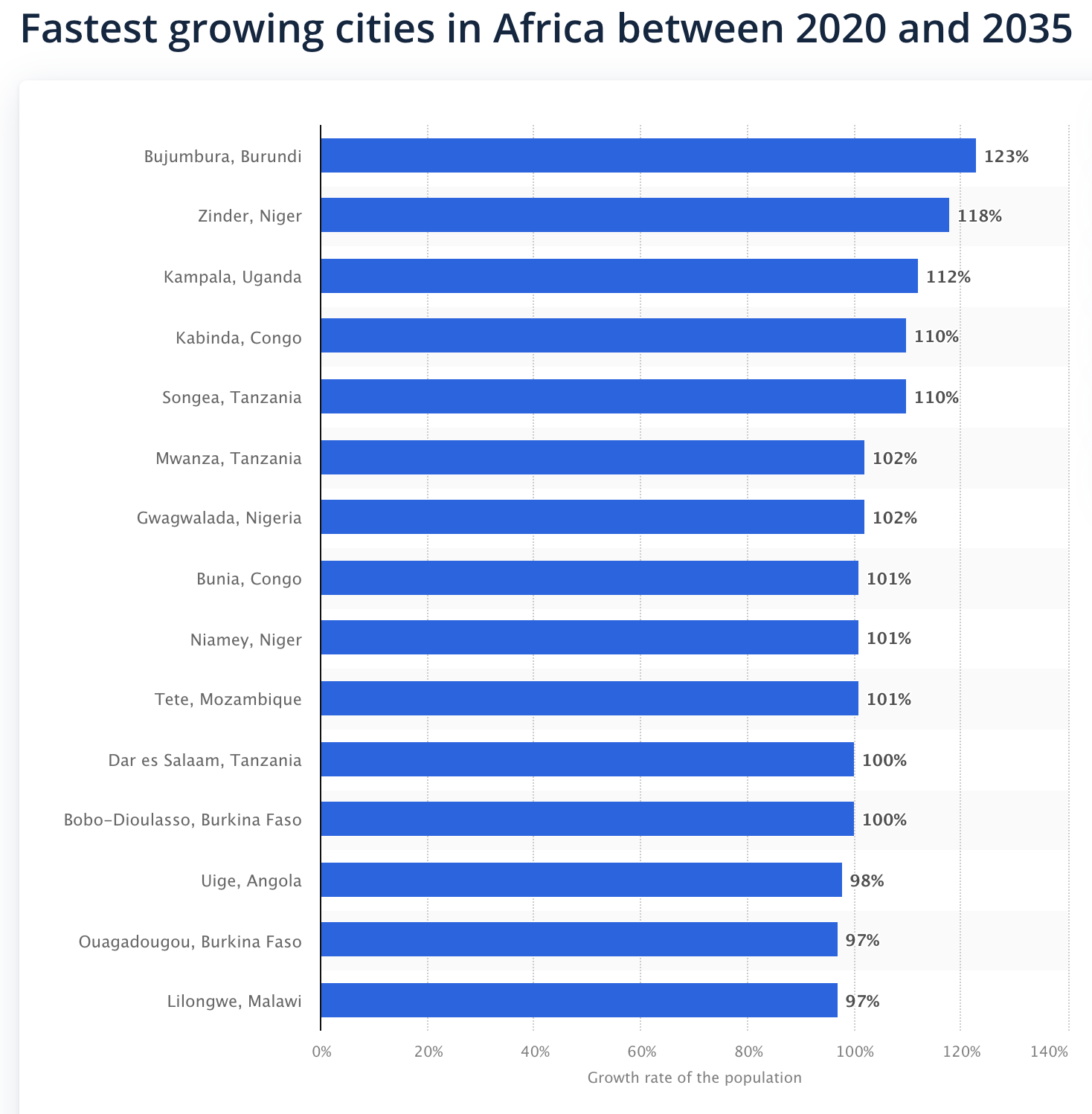
    However, despite Abuja’s substantial population growth, a report titled ‘Fastest growing cities in Africa between 2020 and 2035,’ published by Statista in February 2022, did not list Abuja among the top three fastest-growing cities in Africa. In the report, 15 cities across 10 African countries including Nigeria were ranked based on the growth rate of their population.

    Screenshot of Statista’s rankings

    The report states, “The fastest growing city in Africa is Bujumbura, in Burundi. In 2020, this city had an estimated population of about one million. By 2035, the population of Bujumbura could increase by 123 percent and reach roughly 2.3 million people. Zinder, in Niger, had about half million inhabitants in 2020 and, with a growth rate of 118 percent, is Africa’s second fastest growing city.” 

    It added, “As of 2021, the largest city in whole Africa is Lagos, in Nigeria. Other highly populated cities in Africa are Kinshasa, in Congo, Cairo, and Alexandria, both located in Egypt.”

    Furthermore, Bujumbura’s 2024 population is estimated at 1,277,050, with a 5.8% growth rate from 2023, according to the World Population Review. This is corroborated by a report from Macrotrends.

    Verdict: ALL WE KNOW

    Despite Abuja’s substantial population growth, reports from the World Economic Forum in 2020 and Statista in 2022 identify Bujumbura, Burundi’s capital, as the fastest-growing city in Africa.

  • FACT CHECK: Was the former deputy governor of Anambra State assassinated during Peter Obi’s tenure as governor?  

    FACT CHECK: Was the former deputy governor of Anambra State assassinated during Peter Obi’s tenure as governor?  

    The story of the (now-freed) kidnapped family in Abuja sparked outrage on social media. Members of a family of five, known as the #najeebaandhersisters, were kidnapped at their home, and their abductors demanded a ransom of 60 million naira. The family was unable to raise the ransom and turned to social media for assistance.

    This elicited a flurry of reactions from the public. Political commentators also weighed in, using the opportunity to discuss what their candidates could have done better.

    An X (formerly Twitter) user, Joseph Onuorah, a social commentator and supporter of Labour Party presidential candidate Peter Obi, commented, saying that his candidate would have been proactive in rescuing victims. He said, “Imagine if HE Peter Obi is president and you kidnap a whole family and run to the forest… That will mean the end of existence of that forest. After rescue, It will be turned to National Park and amusement center in a matter of days! That’s what serious Presidents do. “  

    Bashir Ahmad, the digital communications assistant to the immediate past president, Muhammadu Buhari, and a member of the All Progressive Party (APC), responded to the political taunt by claiming that a former deputy governor of Anambra state was kidnapped and killed during Peter Obi’s tenure as governor, even after his family paid the demanded ransom. 

    “Did you know that during Peter Obi’s tenure as governor of Anambra, the state’s former deputy governor, Dr. Chudi Nwike, was kidnapped, taken to a forest, and killed, even after the victim’s family paid a ransom? The only reason I won’t ever pray for Peter Obi’s presidency is because it is taboo to wish bad things upon your own country.” 

    Claim: Was the former deputy governor of Anambra State assassinated during Peter Obi’s tenure as governor? 

    Verification: 

    The CDD War Room investigated the claim and discovered that Chudi Nwike served as Anambra State’s deputy governor from 1991 to 1993. He served as Chukwuemeka Ezeife’s deputy on the Social Democratic Party (SDP) ticket before the military sacked them. 

    On March 19, 2013, Nwike was kidnapped in his home state of Anambra. His kidnappers demanded a ransom of 30 million naira, which was negotiated down to 5 million and paid by his family. After the ransom was paid on April 5, 2013, the kidnappers cut off communication and became unreachable. The former deputy governor’s body was found a few days later, slain in the middle of the road near Agbor, Ika South LGA, Delta State.  

    Peter Obi was the top political official in Anambra State from 2007 to 2014, and he was in office as the governor of the state when the unfortunate incident occurred.

    Verdict: True.

    Chudi Nwike, the former deputy governor of Anambra State, was kidnapped and murdered during Peter Obi’s tenure.

  • FACT CHECK: Has Ousmane Sonko been disqualified from running for president in Senegal? 

    FACT CHECK: Has Ousmane Sonko been disqualified from running for president in Senegal? 

    On January 20, 2024, Bloomberg Africa tweeted a picture of Ousmane Sonko with a link attached. The image had this caption: “Senegal’s main opposition leader, Ousmane Sonko, has been disqualified from running for president in next month’s elections.”

    The report has been circulated across several news platforms, blogs and social media pages ahead of Senegal’s presidential election slated for February 25th, 2024.

    Claim: Ousmane Sonko has been disqualified from running for president in the February 25th presidential election in Senegal

    Verification

    Ousmane Sonko is the presidential candidate of Patriotes africains du Sénégal pour le travail, l’éthique et la fraternité (PASTEF), also called The African Patriots of Senegal for Work, Ethics and Fraternity or just Patriots of Senegal. PASTEF is the major opposition political party in Senegal and was founded in 2014 by Ousmane Sonko. He was the party’s flagbearer in 2019, contested and came third. 

    In July 2023, Sonko’s PANDEF party was dissolved for allegedly stoking civil unrest and rallying his supporters for violent protests, which led to a clash with the police in Dakar, the capital of Senegal. Shortly after, he was arrested and detained for alleged insurrection, undermining state security, criminal association with a terrorist body and theft. Sonko remains in prison to date and considers the victimisation, various charges and convictions as plots to keep him out of the presidential election.

    Ahead of the presidential election slated for February 25, 2024, while still in prison, he remains one of the frontline presidential candidates, indicating that the presidential poll will be a political tussle between him and Amadou Ba of the ruling party. 

    However, there was a twist as the Constitutional Council named 20 candidates out of 79 applications the body reportedly received. According to the list released by Senegal’s highest election authority, the Constitutional Council, Ousmane Sonko and a host of other presidential candidates were disqualified from contesting the election. 

    The Constitutional Council said his disqualification from the ballot was because he faces a six-month suspended sentence following his conviction for defamation. Sonko, who had earlier approached the Supreme Court to overturn the conviction, was dealt a blow as the highest court in Senegal upheld the defamation conviction against him. 

    Acting on this Court verdict, the Council said according to Senegal’s electoral code, Sonko’s conviction makes him ineligible for the presidential race. They added that the conviction “renders him ineligible for a period of five years.” 

    Other frontline candidates disqualified by the Constitutional Council included Karim Wade, the son of former Senegalese president, Abdoulaye Wade. The Constitutional Council said he was ineligible for the ballot as he had dual citizenship when he formally declared his presidential candidacy.

    Verdict: TRUE

    The CDD War Room found that Ousmane Sonko is facing a six-month sentence in prison, having been convicted of defamation. His candidacy was disqualified by Senegal’s Constitutional Council after the Supreme Court pronouncement. Therefore, the embattled PANDEF aspirant will not contest the presidential election slated for February 25, 2024.