Home Home

Home

  • Overview of Key Issues in the Pre-Election Period for the June 18, 2022 Ekiti State Governorship Election (Pre-Election Press Statement)

    Overview of Key Issues in the Pre-Election Period for the June 18, 2022 Ekiti State Governorship Election (Pre-Election Press Statement)

    T
    he first of two off cycle governorship elections for 2022 will be conducted by the Independent National Electoral Commission (INEC) in Ekiti State, on June 18, 2022. The election is the seventh in the state since the return of the current democratic dispensation in 1999. Following a 2010 Court of Appeal verdict, which removed then Governor Segun Oni, and declared Dr. Kayode Fayemi the rightful winner of the 2007 governorship election, Ekiti became one of several states holding off cycle governorship elections. The June 18, 2022 Ekiti State gubernatorial election is the very first to be conducted under the amended Electoral Act, 2022.

    As voters in Ekiti State head to the polls for tomorrow’s governorship election, the contest is apparently shaping up to be a three horse race involving the ruling party in the state, the All Progressives Congress (APC), the opposition Peoples Democratic Party (PDP) and the Social Democratic Party (SDP), which has clearly emerged as a third force in the election. CDD observes that there are 16 political parties fielding candidates for the election. Only two candidates and seven deputy governorship candidates are women, just as the age range of the candidates indicate low participation of the youth.

    The CDD EAC will be closely observing the electoral process with the objective of collecting data to support evidence-based analysis of key aspects of the Ekiti State governorship election. The CDD EAC will also host a fake news hub for the purpose of tracking and countering fake news and misinformation as it affects the election.

    Pre-Election Observations

    Based on the observation of the CDD EAC in the pre-election period, the following are the key trends, which have underlined the process.

    CDD notes that the June 18, 2022 Ekiti State Governorship election is significant because it will serve as the first dress rehearsal as the INEC prepares for the 2023 general elections. The election will also be the first to be conducted under the Electoral Act, 2022, and the new INEC guidelines and regulations for conduct of elections. CDD EAC further notes that although INEC has made commitments to conduct a credible election in Ekiti State, its success in this regard would depend on its neutrality, professionalism and the level of its understanding and commitment to the new legal framework. The credibility of the process would also depend on how well INEC uses some of its new powers as derived from the extant electoral law, especially the power conferred on the Commission to delay the release of election results, if the Commission needs to take a second look.

    The CDD EAC is concerned about violence, money politics and violations of incumbency powers and the possible effects of these on the credibility of the election. CDD EAC notes that Ekiti State, has recorded several incidents of violence during previous elections. In the build up to the 2022 governorship election, pockets of election-related violence have been recorded in places like Ado Ekiti, Efon Alaiye, Oye, Ido/Osi and Oye Ekiti. Other observable issues, which would shape the credibility of the election include; how well INEC is able to effectively deploy technology, particularly the Bimodal Voter Accreditation System (BVAS), impartial security provisioning, the quality of results management, curtailing the role of money, incumbency and god fatherism in the election. Also critical is the need for stakeholders in the election to proactively track, and counter fake news and misinformation. Already, the pre-election period has witnessed the spread of fake news capable of undermining voter confidence and participation in the process. An example is the fake news which trended recently on a purported Appeal Court decision nullifying the primaries of one of the major political parties and, by extension, its candidate.

    In terms of some of the election risk factor, CDD notes that the ongoing strike by the Academic Staff Union of Universities ( ASUU) has crippled the local economy especially in university towns in Ekiti State. This has created a threat in terms of the availability of idle youth being recruited for activities, which could undermine the credibility of the election. By grounding the local economy, the strike has also created the wrong incentives as voters are more likely to see the election as an opportunity for economic survival, thereby exacerbating the risk of vote buying. This becomes even more relevant when it is considered that Ekiti State introduced the issue of “stomach infrastructure” into the Nigerian political lexicon. CDD has also observed that based on history of past violence in elections in the state, the following Local Government Areas, constitute potential flash points in the election; Ado Ekiti, Efon Alaiye, Ido/Osi, and Oye.

    Signed:

    Professor Adele Jinadu

    Chair, CDD EAC

  • FACT SHIELD: What to know about November 11 Governorship election in Imo state

    FACT SHIELD: What to know about November 11 Governorship election in Imo state

    During the general elections of February and March, gubernatorial polls were held in only 28 states of the federation, leaving out eight states where off-cycle elections will subsequently be held.

    Off-cycle elections will take place in Imo, Kogi, and Bayelsa states on November 11, 2023. 

    This Explainer will focus on Imo State and the specifics of what you need to know about the state’s upcoming elections. 

    Why is there an off-cycle election in Imo State? 

    The electoral calendar in Imo State was disrupted in 2020 when Emeka Ihedioha of the Peoples Democratic Party (PDP), who won the gubernatorial election in 2019, was sacked by the Supreme Court and replaced with Hope Uzodinma of the All Progressives Congress (APC). 

    The Supreme Court ruled unanimously that the votes attributed to Uzodinma from approximately 388 polling units were unlawfully excluded during the final collation of the general results. He was subsequently declared the winner of the election. 

    Who are the candidates for the 2023 guber poll? 

    The Independent National Electoral Commission (INEC) has listed 17 candidates from 17 political parties contesting for the election.  

    However, one PWD (person with disability), the Labour Party candidate, is one of the top three contenders in the race. There are three main contenders among the 17 parties: the All Progressives Congress (APC), the party of the incumbent governor, Hope Uzodinma, who is running for reelection; the Peoples Democratic Party (PDP), whose candidate, Samuel Anyanwu, is the party’s national secretary; and the Labour Party (LP), whose flag bearer, Athan Achonu, is said to be the first governorship candidate with a disability. He calls himself the “one-armed lion.” 

    What are their educational qualifications?

    Hope Uzodinma holds an ordinary and higher diploma in Maritime Management Technology from the Federal University of Technology, Owerri. He went on to Washington University in St. Louis to study diplomacy and international relations. 

    Samuel Anyanwu holds a Masters Degree in Political Administration from the University of Port Harcourt. He also has degrees from Cambridge University, Judge Business School, and Harvard Kennedy School. 

    Athan Achonu attended a government secondary school in Umuahia, Abia State, before going on to John Cabot University in Rome, Italy, where he earned a bachelor’s degree in agronomy.  

    Is there a woman in the race? 

    According to INEC’s breakdown, there are no female gubernatorial candidates, though two of the 17 political parties have women as running mates. 

    Nnedinma Ekomaru, the APC’s deputy governorship candidate and Hope Uzodinma’s running mate, is a woman and a lawyer. Her husband was a former PDP governorship candidate in the state and a political ally of Samuel Anyanwu, the PDP’s candidate for governor in 2023. Uzodinma is said to have dropped the incumbent deputy governor, Placid Njoku, who was his running mate in 2019. 

    Vivian Ottih, a lawyer and journalist, is the Action Democratic Party’s (ADP) deputy governorship candidate. She is the chairperson of Imo State’s National Association of Women Journalists (NAWOJ). She had previously been a member of the People’s Democratic Party and had run for the House of Assembly under the party’s banner.

    Controversies

    In the run-up to the off-cycle election, political parties and their candidates have been embroiled in a slew of controversies. Two factions of the Labour Party held separate primaries, and the winners of those primaries made claims to the ticket. The Apapa faction claimed that the Abure faction’s primaries were invalid, and Achonu’s election was challenged in court. Achonu’s election was subsequently recognised as valid.

  • FACT SHIELD: What to Know about November 11 Bayelsa Governorship Election

    FACT SHIELD: What to Know about November 11 Bayelsa Governorship Election

    As voters in Bayelsa State in the South South geo-political zone head to the polls to elect a governor on November 11 2023, it is important for voters and all stakeholders in the electoral process to familiarise themselves with the gubernatorial candidates, the salient issues and the political landscape. 

    The Gubernatorial Candidates

    On June 6, 2023, the Independent National Electoral Commission (INEC) published the final list of candidates for the governorship election scheduled for November 11, 2023. 

    INEC National Commissioner and Chairman of the Information and Voter Education Committee, Festus Okoye, said in a statement that the commission approved the final list of candidates for the three off-cycle governorship elections scheduled to be held in Bayelsa, Imo, and Kogi at its regular meeting.

    According to INEC, 16 candidates from 16 political parties are vying for the governorship position. Of all the 16, only two are female candidates, while the remaining 14 are male. 

    Of all the 16 candidates, the three leading contenders are the incumbent governor, Duoye Diri of the Peoples Democratic Party (PDP), Timipre Sylva of the All Progressives Congress (APC), and Eradiri Udengmobofa of the Labour Party (LP). 

    It is important to note that the three leading candidates have had various stints in government over the years. Sylva Timipre of the APC served as the governor of Bayelsa state between 2007 and 2012. He was later appointed as the minister of state petroleum in August 2019. Timipre is seeking a second term in the November 11 election. 

    Duoye Diri, the incumbent governor, is seeking a second term after being declared the winner by the Supreme Court four years ago. The Supreme Court sacked the initial winner of the election, David Lyon and his deputy, Biobarakuma Degi-Eremienyo, after nullifying their election over discrepancies in the document submitted by David Lyon’s running mate. Duoye Diri of the PDP, who came second, was subsequently sworn in. Having completed his first four year tenure, Diri is contesting for re-election.

    Eradiri Udengmobofa of the Labour Party (LP) is largely perceived as the third force in the highly anticipated Bayelsa gubernatorial election. His foray in competitive politics started in 2011, when he contested for the Federal House of Representatives for the Kolokuma / Okpokuma Yenagoa Federal Constituency seat under the Labour Party. He however lost and has since then served in various other capacities including as Bayelsa state Commissioner for Youth Development between 2018 – 2019, and Commissioner for Environment, between 2019 -2020. Eradiri served in the cabinet led by Duoye Diri; whom he is contesting against in 2023. 

    Education Qualifications of the Candidates

    ERADIRI, Udengmobofa Udengs, of the LP is a graduate of the University of Benin with a degree in Production Engineering and a certificate in Dredging Technology from the A&M University Texas USA. 

    Duoye Diri of the PDP studied at the College of Education, Port-Harcourt, Rivers State, where he obtained a National Certificate in Education (NCE) in 1985. He graduated from the University of Port-Harcourt, obtaining a Bachelors of Education (B.Ed.) degree in political science in 1990. 

    Timipre Sylva of the APC graduated from the University of Port Harcourt with distinction in English (Linguistics) in 1986. He was the best graduating student from his department and departmental valedictorian.

    Therefore, the highest qualification (tendered and published by INEC) of the three leading aspirants is a first degree. 

    Gender Balance

    Based on the published list by INEC, of the 16 candidates, just two are woman. Oguara Nengimonyo of the Action Democratic Alliance (ADP) and Ogege Kemelayefa Mercy of the Action Peoples Party (APP) are the two female guber candidates slated for the November 11 election. They are 41 and 35 years old respectively. 

    In addition, two women were chosen as running mates by the candidates of the Social Democratic Party (SDP) and the Action Alliance. They are Doibo Ebinabo and Okoya Ladebi Lillian aged 40 and 35 respectively. 

    This breakdown shows that of all the 32 candidates drawn from 16 political parties, four represent the “women constituency.” However, neither of these four is among the three dominant political parties in the state. 

    Age Distribution

    Of all the 16 governorship candidates, the Action Peoples Party (APP) is fielding the youngest in the race at 35 years old while the All Progressives Grand Alliance (APGA) has fielded the oldest candidate at 66 years old. 

    For the deputy governorship candidates, the Action Alliance (AA) has the youngest candidate at 35 years old while the Labour Party (LP) has the oldest candidate at 64 years old. The average age for the governorship and the deputy governorship candidates stands at 47.3 years.

  • FACT CHECK: Did Macron say France would not ‘hand over’ Burkina Faso, Mali, and Niger?

    FACT CHECK: Did Macron say France would not ‘hand over’ Burkina Faso, Mali, and Niger?

    Emmanuel Macron, the president of France, has been quoted as saying in a video that his country would not hand over Burkina Faso, Mali, and Niger. The claim was posted on X, formerly known as Twitter, alongside the video of Macron. 

    At the time of retrieval from the microblogging platform, the post, made by a verified X user on September 2, 2023, had garnered three million views, 4,373 reposts and 10,000 likes. 

    Screenshot of the viral post on X

    This comes as a political crisis rocks West and Central Africa over an upsurge in the number of military takeovers on the African continent. 

    Claim: Emmanuel Macron said France would not hand over Burkina Faso, Mali, and Niger in a video

    Verification

    The CDD War Room observed that the video posted alongside the quote shows the moment when Macron was speaking at the Conference of Ambassadors held in Paris, capital of France, on August 28, 2023.

    In the 20-second video posted by the verified X user, Macron could be heard speaking in French, as translated: “If France had not intervened, if our military had not died (in battle) in Africa, if Serval and Barkhane had not been decided, we wouldn’t have Mali, Burkina Faso and Niger today.”

    We further checked Macron’s full speech at the conference and found that he didn’t say France would not hand over Mali, Burkina Faso, and Niger. The statements that followed what he said in the viral video read, “These States would no longer exist with their current borders. I can say that with certainty. And so when I sometimes hear even from French political leaders that Barkhane was a failure, I say that you must not use the enemy’s arguments because that does a disservice to everyone. You are paying a strange tribute to our troops.”

    Verdict: Misleading

  • FACT CHECK: Was N355 Billion Spent on Acquisition of BVAS? 

    FACT CHECK: Was N355 Billion Spent on Acquisition of BVAS? 

    On September 10, 2023, Dele Momodu, a politician and publisher of Ovation Magazine, who served as the director of strategic communications for the Peoples Democratic Party (PDP) Presidential Campaign Council, posted on his Instagram page, “N355 billion for BVAS and 5 person’s said it wasn’t necessary to use it? Isn’t that laughable? Oh, what a country? 

    This assertion is coming few days after the 5-member panel of justices delivered their judgement on the 2023 presidential election petitions. In the ruling, the judges unanimously affirmed that INEC is not mandated to electronically transmit election results.

    However, there was no petition or ruling bordering on the use of BVAS as the machine was used across all polling units in the concluded general election with a 98% success rate.

    Claim: N355 billion was spent on BVAS

    Verification

    What is BVAS? 

    The Bi-Modal Voter Accreditation System (BVAS) is an electronic device introduced by the INEC in 2021 to read Permanent Voter Cards (PVCs) and authenticate voters’ biometrics using both the voters’ fingerprints and facial recognition in order to prove that they are eligible to vote at a particular polling unit. 

    The device is also used for capturing images of the polling unit result sheet (Form EC8A) and uploading the image of the result sheet on INEC’s Election Result Viewing platform (IReV).

    How much was spent on BVAS? 

    In December 2021, Mahmud Yakubu, the chairman of the Independent National Electoral Commission (INEC), appeared before the National Assembly, where he said the electoral commission would spend 305 billion for the 2023 elections. He defended the budget when he appeared before the Senate Committee on Appropriations and explained that the fund would be used for operational costs covering, printing of ballot papers, result sheets, printing of forms and envelopes, arterials and supplies, logistics expenses, honorarium for officials, supervision, RAC preparation, security /intervention support etc.

    In November 2022, the INEC chairman appeared before the Senate Committee on INEC, and while defending the commission’s annual budget, he said the projected annual expenditure for 2023 stands at N50 billion.

    According to the INEC Election Project Planning Committee, the commission would spend N161.9 billion for elections operational and administrative costs, N117.1 billion for election technology costs, and N18.5 billion for electoral capital costs. The acquisition of BVAS falls under the N117.1 billion earmarked for election technology costs. 

    Therefore, the commission budgeted N50 billion for its annual expenditure, while N305 billion was budgeted for the 2023 elections, totalling N355 billion. It is out of the N305 billion that the commission earmarked N117.1 billion and part of it would be used to purchase 200,000 units of BVAS machines.

    Verdict: MISLEADING

    The claim that N355 billion was spent on BVAS is misleading as INEC announced that its total budget was N355 billion. Out of the N355 billion, N305 billion was budgeted for the 2023 general election across the 36 states of the federation and the FCT, while N50 billion was projected as the commission’s annual budget for 2023. Hence, out of the N305 billion, the commission planned to spend part of the N117.1 billion on BVAS. 

  • FACT CHECK: Did the tribunal say that candidates should not depend on INEC for election results? 

    FACT CHECK: Did the tribunal say that candidates should not depend on INEC for election results? 

    It is being circulated on social media that Justice Mistura Bolaji of the Presidential Election Petition Tribunal, while delivering her judgment on the petitions filed by Peter Obi and Atiku Abubakar, stated that candidates should not depend on INEC for electoral results.

    Both Obi and Atiku had earlier petitioned the court to void the declaration of Bola Ahmed Tinubu as the winner of the February presidential elections.

    A quote attributed to her reads, “Any serious candidate cannot and should never depend on INEC for electoral result.” -Justice Bolaji-Yusuf Misturah. 

    The claim has been widely circulated in different forms. 

    Verification

    While aligning with the lead judgement delivered by Justice Tsammani, Justice Mistura spoke about the evidence presented by the petitioners in the case. 

    She stated that paragraph 9 of the regulation provides for a political party, the right to appoint one person as its polling agent for each polling unit, collation centre, and one representative at each point of distribution of electoral materials in the constituencies where it is sponsoring candidates for an election. 

    She held that while PW12 (petitioner witness) admitted that the party exercised that right and had 133,000 polling agents during the election, the petitioners did not invite any of these polling unit agents to give evidence, and not one of the result forms collected by these agents was tendered in evidence.

    She went on to state that the Electoral Act makes provision for forms on which results are entered, and which are signed by INEC and party agents. The Justice noted that the duplicate of the result sheet is usually given to the party agents, and that these are potent materials for any candidate who wishes to challenge the result declared by INEC.

    In her words, “any serious candidate ought not to depend on INEC for materials to prosecute its petition. According to Section 167(d) of the Evidence Act, the failure of the petitioners to produce election result forms collected by their agent raises a presumption that if those forms had been produced, it would have been unfavourable to the petitioners.”

    Verdict:

    MISLEADING 

    CDD War Room was present at the Tribunal when it delivered its verdict on Wednesday, and can confirm that the Justice statement made no reference to the constitutional responsibility of INEC to conduct elections and declare results. Instead, her point focused on the responsibility of candidates challenging election results, to provide evidence collected through their party agents to support their petition in line with extant laws.

  • FACT CHECK: Is this Peter Obi shaking hands with Bola Tinubu?

    FACT CHECK: Is this Peter Obi shaking hands with Bola Tinubu?

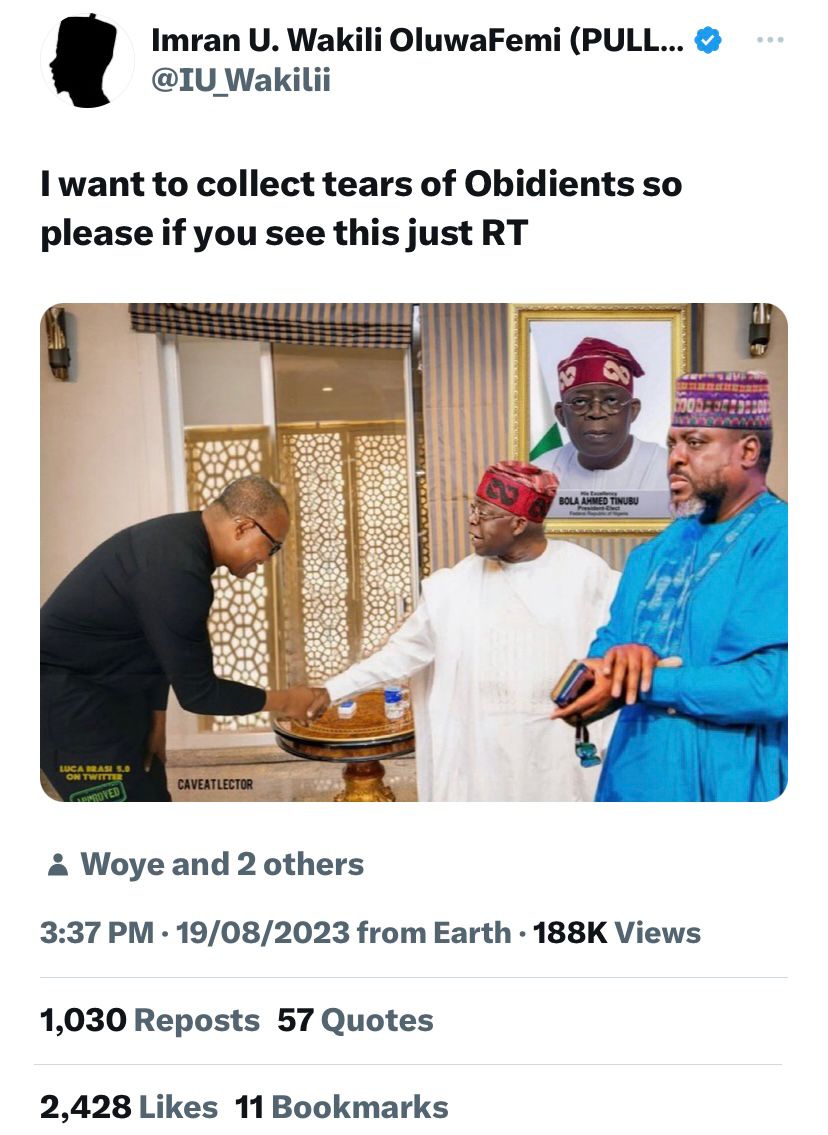
    On August 19, 2023, an X user (formerly Twitter) posted a photo showing Peter Obi, the presidential candidate of the Labour Party, bowing and shaking hands with Nigeria’s president, Bola Ahmed Tinubu. The user, an avid Tinubu supporter of Bola Ahmed Tinubu, posted the photo with the caption: “I want to collect the tears of Obidients, so please, if you see this, just RT.”

    As of the time of this report, the post had been viewed over 180 thousand times, with over 1,000 reposts, 57 quotes, and over 2,000 Likes.

    screenshot of the viral post

    Verification: 

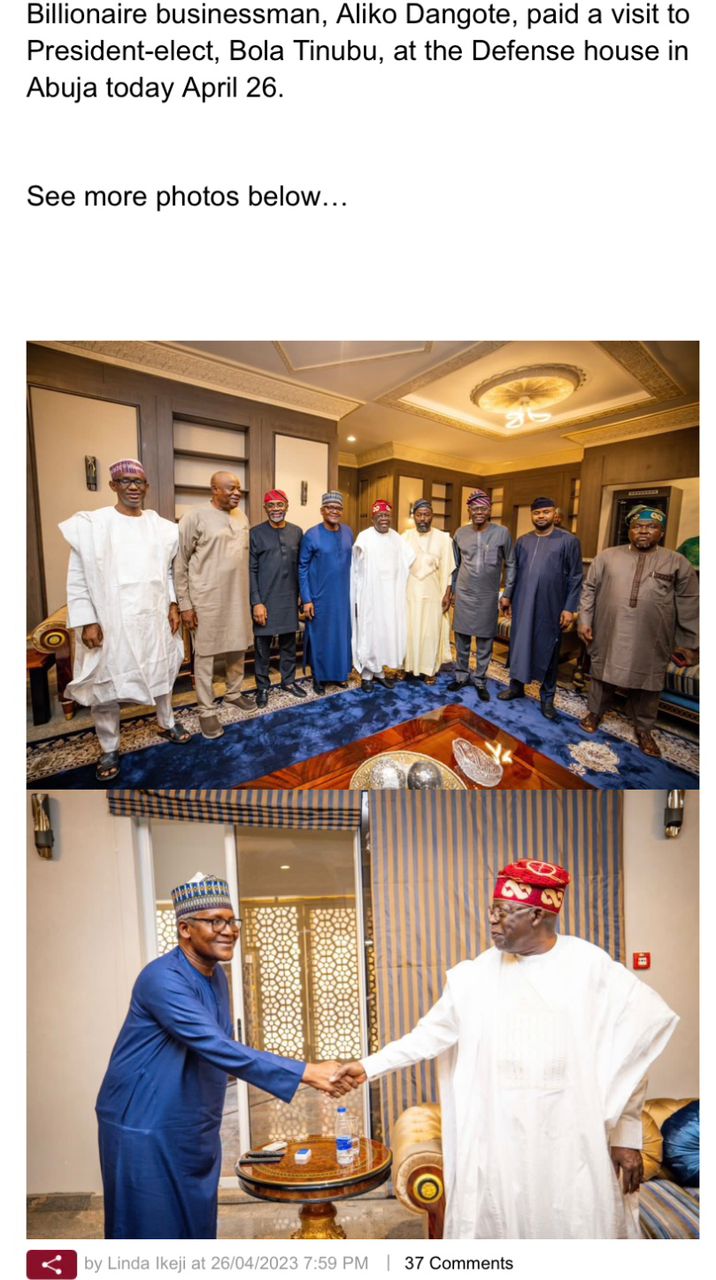
    The image was examined using Google Reverse Image Search, which revealed that it had been edited with image manipulation software. The search led us to the original image, which shows Bola Ahmed Tinubu exchanging pleasantries with billionaire businessman, Aliko Dangote when the latter paid Tinubu a visit at the Defence Headquarters on April 26, 2023.

    Investigations show that Dangote’s image had been cropped out and replaced with Obi’s image in the photo.

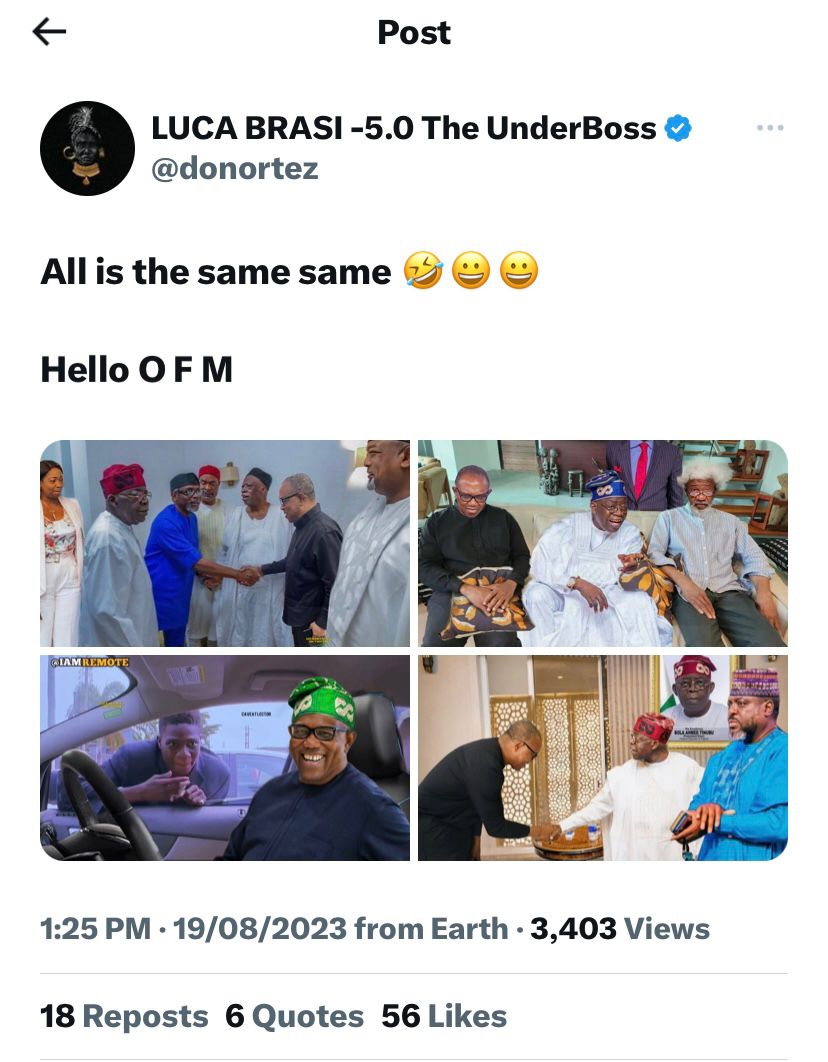
    It was discovered that the photo was originally created by an X (formerly Twitter) user

    A thorough examination of the account’s activities reveals that the user frequently manipulates images of public figures and politicians, particularly those of Peter Obi and Bola Ahmed Tinubu. In a post, the user declared himself the official BAT “photoshopper”.

    The photo was also customised with the Latin phrase “Caveat lector”, modelled after “caveat emptor” which means “Let the readers beware”. It warns a reader to take careful note of the content of what he reads and to undertake due diligence on whether the contents are accurate, relevant, or reliable.

    Verdict: False

    Conclusion

    The claim that Peter Obi was exchanging handshakes with President Bola Ahmed Tinubu is False. Investigations show that the photo has been manipulated.

  • FACT CHECK: Did Angry Camerounians Disrupt President Biya’s 40 Years in Power Celebration in France?

    FACT CHECK: Did Angry Camerounians Disrupt President Biya’s 40 Years in Power Celebration in France?

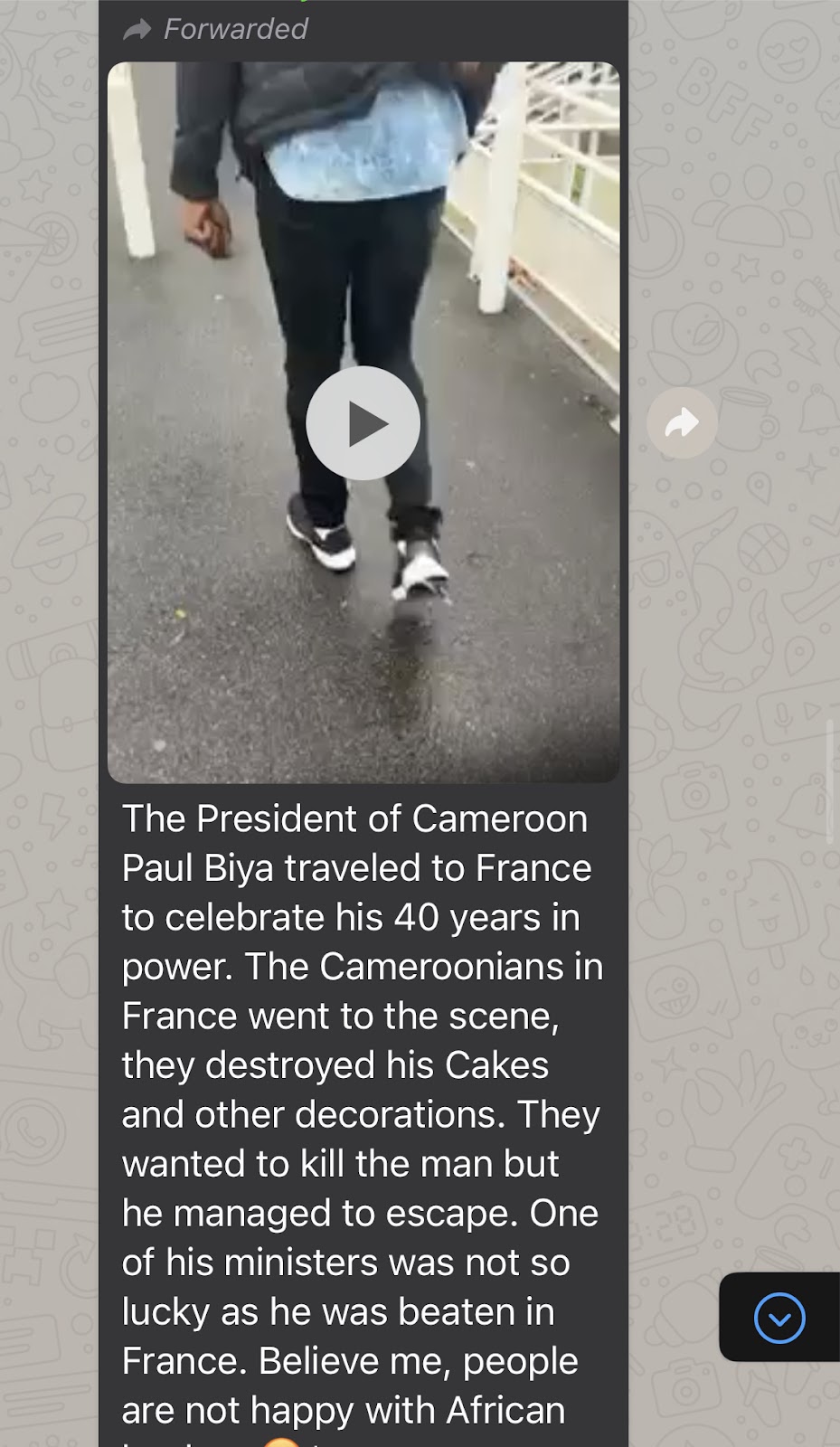
    A video making the rounds on Whatsapp depicts the moment angry Cameroonians stormed the venue of an event said to be the celebration of President Paul Biya’s 40th year in office.  

    We transcribed the video, which is originally in French to English and the people in the video were saying, “Come out, get out, what is happening? Please be careful, what are you doing? 

    You can not enter, what are you doing? 

    The RDPC can not celebrate the diaspora. What celebration? 40 years of massacre, 40 years of murder, and you are celebrating

    The RDPC can not hold any anniversary here. The dictatorship you are showing there will be shown to you here. No anniversary for the pole bearer here. Mission accomplished. Come out, kill him and others shouted No, No. They echoed, “The RDPC are running away; what are you celebrating, criminals? Are you not ashamed of celebrating an old man?” 

    Verification

    The video was first uploaded to the internet on November 18, 2022, by a Facebook page, “Lighthouse News Zimbabwe.” On the same day, the exact version of the video with a similar caption was shared on Twitter. Less than a year later, a version of the video with the caption is being shared across social media pages.

    The CDD War Room found that the RDPC mentioned in the video alleged to be holding celebrations is the “Rassemblement démocratique du Peuple Camerounais,” which also connotes the Cameroun People’s Democratic Movement (CPDM). Paul Biya, the president of Cameroon, doubles as the National president of the party, which has dominated Cameroun’s political space since the 1960s. 

    We found that the Cameroun president, aged 89, has spent 40 years in power, having taken over as the president in 1982. Biya took over from Ahmadou Ahijo, having served as prime minister since 1975.

    He has won all multiparty elections since 1992, and the opposition has always complained of heavy election rigging. In 2008, Biya abolished the constitution’s two-term limit, giving him the leeway to rule for as long as he wants. 

    Verdict: TRUE

    The claim of the disruption of the event portrayed in the video is true; the events could be traced to the venue of Paul Biya’s 40 years in power celebration in France. However, the event occurred in November 2022, not recently as being portrayed by those circulating it. 

  • Gabon at a glance; All You Need to Know About the Coup

    Gabon at a glance; All You Need to Know About the Coup

    Gabon, also known as the Gabonese Republic, is a country in Central Africa. It shares borders with Cameroon, Equatorial Guinea, and the Republic of Congo. Gabon’s population is estimated to be 2.3 million people. The country is endowed with natural resources and, like Nigeria, is an oil producer and net exporter of crude oil. 

    Despite its abundant natural resources, the country’s economic performance is poor. The World Bank estimates Gabon’s GDP in 2022 to be around 3.1%

    Gabon ranks higher than Nigeria in the Global Human Development Index. The index measures the three key dimensions of human development: living a long, healthy life, being knowledgeable, and having a decent standard of living. Gabon was ranked eighth in Africa in 2021, with Nigeria ranked 28th. Gabon is ranked 112nd in the world, while Nigeria is ranked 163rd. 

    Political Landscape. 

    Gabon gained independence from France on August 17, 1960, and has had three presidents since that time. In 1961, Léon Mba was elected president; his deputy was Omar Bongo Ondimba, the father of Ali Bongo, Gabon’s recently ousted president. 

    After Léon M’ba died in office in 1967, Omar Bongo Ondimba took over as president.  He ruled for nearly 42 years before succumbing to a cardiac arrest in 2009. Ali Bongo, his son, succeeded him as president. Since its independence, the Bongo family has ruled the country for 55 of its 63 years. 

    From one party to pseudo multi party State

    Gabon had a multiparty system until 1967, when Omar Bongo Ondimba took over. He dissolved the Bloc Démocratique Gabonais (BDG), leaving only the Parti Democratique Gabonais (PDG) as the country’s political party. In 1991, Omar Bongo permitted a multiparty system, though his political party, the PDG, remained the major and dominant party.

    Elections and a coup?

    A coup is an illegal takeover of power from a government. It could occur within military ranks as well as in a democratic context, such as when the military seizes power from a democratically elected government. Gabon had experienced a number of coup attempts prior to 2023. There was an unsuccessful coup attempt in 2019; there were also two failed coup attempts in 1990. 

    The 2023 coup is said to have been triggered by the recent election, in which Ali Bongo was declared the winner for a third term in office. The absence of international observers, the shutdown of the internet, and the imposition of a curfew characterised the electoral process. The entire process was described as fraudulent by the opposition. 

    It is worth noting that Brice Clothaire Oligui Nguema, the commander-in-chief of the Gabonese Republican Guard – the country’s most powerful security unit – and Bongo’s cousin, is the ringleader of the latest coup.

  • Fact Check: Did Appeal Court declare LP’s Pela Governor of Delta state?

    An X (formerly Twitter) user during the week insinuated that Ken Pela, the Labour Party gubernatorial candidate of Delta state had won a court case thus making him the governor of the state. The post read, “Guys we won we won. Delta is Labour party, Governor Ken Pela won the case in court. The judiciary did it. Labour party is taking over Delta state. Delta is Labour.”

    The post as at the time of this fact-check had over 117,000 interactions.

    Claim: Appeal court declares Labour Party’s Pela as Delta state Governor

    Verification

    CDD War Room in determining the veracity of the claim contacted a staff of the Appeal court in Abuja who explained that the court had not declared Pela governor. 

    Also, various reputable media outlets reported that the Appeal court had ordered the Delta State Governorship Election Petition Tribunal in Asaba to re-hear Labour Party’s governorship candidate Ken Pela‘s petition. In his petition, Pela had urged the Tribunal to cancel the election of Sheriff Oborevwori and Ovie Omo Agege who came second. The Labour party gunernatorial candidate based his plea on alleged non qualification of the first two candidates and non-compliance with the provisions of the Electoral Act, 2022.

    The Tribunal, sitting in Asaba, had in July dismissed the petition. The three-member panel of the tribunal headed by C.H Ahuchaogu, held that the petition was ‘incompetent’ and constituted a flagrant violation of the Electoral Act. CDD War Room recalls that LP candidate, Pela, came third with 48,027 votes behind Oborevwori and Omo-Agege who emerged winner and runner up respectively.

    Verdict: MISLEADING

    The claim that LP’s Pela has been declared governor of Delta State through a recent Appeal Court verdict is Misleading. The court only ordered the tribunal to repeat the hearing of the case, which was earlier dismissed.

  • FACT CHECK: Did Tinubu Say He Intends to Abolish Naira and Adopt Dollar As National Currency?

    FACT CHECK: Did Tinubu Say He Intends to Abolish Naira and Adopt Dollar As National Currency?

    A Tiktok user during the week shared a video with the claim that president Bola Ahmed Tinubu has declared his intention to abolish the use of Nigeria’s official currency (Naira) and adopt the United States Dollar in its place.

    The video which has Arise TV’s logo also showed one of the station’s anchor Ojy Okpe as the presenter of the news. As at the time of this fact check, the video report had garnered over 6,000 likes and over 4,000 shares.

    Claim: Tinubu said there are plans to abolish Naira and replace it with the United States Dollar

    Verification:

    The CDD War Room observed several discrepancies in the video, including significant synchronisation issues, especially between the mouth movements and the displayed audio. There were also several grammatical inconsistencies in the composition of the news headline. CDD War Room similarly observed an approximate 5-second pause before the next sequence.

    Using diverse verification methods, we traced the video to a January 11, 2022, Arise TV Morning show broadcast and a Channels TV news report of January 10, 2022. The videos showed when Tinubu, who was at the time one of the major contenders for the presidential ticket of the All Progessives (APC) made his intention public during a visit to President Muhammadu Buhari.

    To detect the manipulation, CDD War Room ran the video through a deep fake scanner which flagged the video as deep fake. Furthermore, we perused the page of the originator of the video and found that the user frequently shared manipulated videos about Tinubu and other influential individuals. A quick internet search also revealed that the claim that Tinubu intends to change Nigeria’s currency to dollars was not reported by any reputable media organizations.  

    Verdict: FALSE

    The CDD war Room found the video to be heavily manipulated by the Tiktok user who combined two unrelated video’s to peddle a false narrative. Multiple checks indicate that there is no plan to change Nigeria’s national currency from Naira to the United States Dollar as contained in the manipulated video.